The number of regions and countries that are putting a price on carbon pollution is vastly increasing. Nearly 40 countries already price carbon or plan to do so, including China that will roll out a national carbon market from 2016 onwards. Linking these different carbon markets is being envisaged by several European policymakers.
Jurisdictions with carbon markets currently account for about 40% of global economic activity (GDP)[1]. Linking these different carbon markets with the ultimate goal of establishing a global carbon market is seen as an integral part of the future climate regime, since it can increase the pool of mitigation options available, thereby reducing costs and allowing countries to increase their climate ambition. These benefits however only materialize if the linked carbon markets have a similar level of ambition and a similar design of a number of key features, such as price controls, quantitative and qualitative restrictions on carbon offsets, and the type of allocation method used. Paradoxically, while lower abatement costs are an important economic motive for linking two emission trading systems, they can also constitute a significant political barrier, since citizens of the higher cost system might be reluctant to pay for emission reductions in the other jurisdiction.
The inclusion of international flights into the EU’s carbon market was one factor that created momentum for a global, rather than regional, measure to address aviation emissions. Recognizing Europe’s potential importance in the ongoing negotiations towards a global market based measure, open letters from fifteen NGOs across Europe were sent to EU’s transport and environment/climate ministers, calling on them to step up in promoting emissions reductions from aviation – a fast-growing and polluting sector.
Sharing experiences with existing climate mitigation mechanisms, such as the Clean Development Mechanism (CDM) and highlighting the severe impacts on basic human rights these UN mechanisms can have, activists from Africa, Asia and Central America met with financial institutions and policy makers involved in financing these projects. The accountability of climate finance was thereby discussed from a European perspective.
The number of regions and countries that are putting a price on carbon pollution is vastly increasing. China, for example, announced that it will roll-out a national carbon market from 2016 onwards, South-Korea’s national cap-and-trade system started early 2015 and South Africa will implement a carbon tax from 2016.
The role carbon markets will play in a future climate treaty to be adopted by the end of this year is still unclear. Yet, several countries and regions, such as Japan and the European Union (EU), see an important role for international carbon markets.
Norway was the third country after Switzerland and the EU to officially submit its climate contribution towards the Paris climate agreement. Like the EU, Norway announced an at least 40% emission reduction target by 2030, which it intends to fulfil jointly with the EU by joining the EU’s 2030 climate framework. While Norway has made it clear that land sector accounting shall not affect its ambition level, the EU has left doors open for forestry accounting tricks. If the EU want to jointly fulfil its 2030 climate target with Norway, the EU must also exclude the option of planting trees to offset emissions.
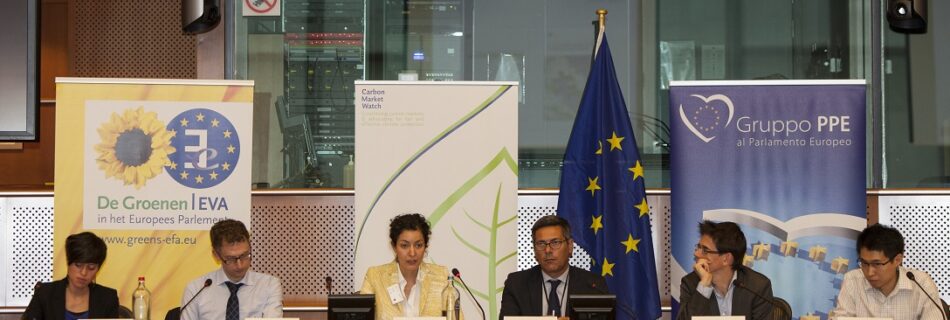
Last week in an event in the European Parliament, various stakeholders discussed experiences with existing climate mechanisms against the future climate finance policy landscape, where potentially huge amounts of climate finance will not only be channeled through the Green Climate Fund (GCF) but also through bilateral agreements and other instruments where it is still unclear what types of safeguards and compliance mechanisms will be applicable and how the respective public and private stakeholders involved will be accountable.
The EU’s carbon market desperately needs to get rid of excess weight if it is to perform as an effective climate change fighting tool in the future. The task of providing a way to do this – for example by permanently cancelling the current oversupply of more than two billions tonnes of CO2 – is now up to the European Commission when presenting its plans to revise the EU’s emissions trading system (ETS) by mid-2015.
On 24 October 2014, the European Council agreed on the 2030 framework for climate and energy [1], including a binding domestic target for reducing greenhouse gas (GHG) emissions of at least 40% in 2030 as compared to 1990. To meet this target, the European Council agreed that the emissions in the EU Emission Trading System should be reduced, compared to 2005, by 43%. A reformed EU ETS remains the main instrument to achieve the emission reduction target. The cap will decline based on an annual linear reduction factor of 2.2% (instead of the current 1.74%) from 2021 onwards, to achieve the necessary emission reductions in the EU ETS. The European Council furthermore gave strategic guidance on several issues regarding the implementation of the emission reduction target, namely free allocation to industry, the establishment of a modernisation and an innovation fund, optional free allocation of allowances to modernise electricity generation in some Member States.