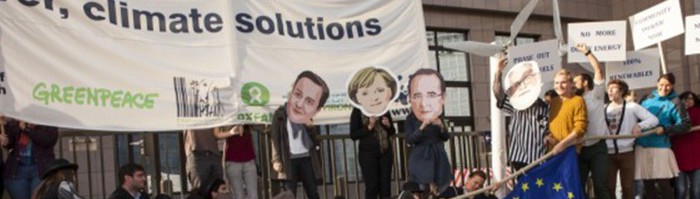
Nature Code with WWF, CAN Europe, Greenpeace, Change Partnership, Transport & Environment, and Friends of the Earth Europe staged an Energy and Climate Tug of War. On the day when EU environment ministers were meeting to sign off their final position before the Paris climate negotiations, NGOs urged EU leaders that a commitment to ambitious …
Read more “Media Action: EU Energy and Climate Tug of War!”
In July 2015, the European Commission presented a legislative proposal to revise the EU’s Emissions Trading System (ETS) in order to implement the EU’s 2030 target of at least 40% domestic emission reductions. Although the proposal suggests a few improvements, it fails to introduce much needed provisions that improve the mitigation potential of the EU ETS.
Just when everyone started leaving for their summer holidays, the Commission published a legislative proposal to revise Europe’s carbon market to make it fit for the post-2020 period. The proposal was heavily criticized for failing to tackle the fundamental flaws of the EU ETS and increasing pollution subsidies to €160 billion to the EU’s biggest carbon polluters. However, there is still a chance for the European Parliament and Member States to turn the EU ETS into an effective tool to tackle climate change.
15 July 2015, Brussels. Today’s publication of the EU Emissions Trading System review proposes to increase pollution subsidies to industry to at least €160 billion after 2020. Carbon Market Watch strongly criticizes the proposal for watering down already weak provisions in the EU ETS directive and ignoring the polluters-pay principle.
Last week Carbon Market Watch presented new analysis on how (not) to reduce the costs of tackling sixty percent of EU’s greenhouse gas emissions, covered by the Effort Sharing Decision (ESD). The report finds that a wrong design could significantly undermine reduction efforts in the transport, agriculture, buildings and waste sectors until 2030 by up to 28%. Early action on the other hand can lead to an extra one billion tonnes of CO2 reduction in the 2021-2030 period.
A new report from the Öko-Institut shows that the use of forestry offsets to replace efforts in other sectors would undermine the EU’s 2030 climate target by 5%. The legislative proposal for the land use sector that the European Commission is expected to present early next year should therefore uphold the environmental integrity of the EU’s 2030 climate target by treating the emissions and removals from our forests and soils completely separate from the efforts of other sectors.
The Effort Sharing Decision (ESD) is a centerpiece of Europe’s climate legislation as it sets annual emission reduction targets for each Member State for the greenhouse gas emissions from the transport, building, agriculture and waste sectors. The ESD was adopted in 2009 to implement the EU’s 2020 climate target and has been designed for the 2013-2020 period. To implement the newly agreed 2030 climate target, the European Commission is expected to present a new legislative proposal to reduce emissions from ESD sectors in the 2021-2030 period in the first half of 2016.
18 June 2015, Brussels. As the European Commission is consulting on options to cost-effectively reduce emissions in sectors not covered by the EU ETS a new study finds that a wrong design could undermine reduction efforts in the transport, agriculture, buildings and waste sectors by three quarters until 2030. This is because potential intra-EU offsetting options currently under discussion – for example allowing carbon permits from the EU ETS or using forestry offsets – do not represent real emission reductions.
Dear Commissioner Arias Cañete,
The European Commission has consulted stakeholders about the role the EU’s land and forests should play in its 2030 Climate and Energy Framework. With this letter, the undersigned organisations are registering their views and state that Option 1 (LULUCF pillar), is their preferred option since it is the only one that could uphold the environmental and social integrity of the EU’s target. They call on the EU to have a clear position ahead of Paris on the need for two distinct global goals, one for LULUCF and another for other emissions, including non CO2 emissions from agriculture.
At the European Summit in October 2014, Heads of State agreed that, by 2030, the EU will domestically reduce its emissions by at least 40 per cent compared to 1990. In the run up to the United Nations climate summit in Paris, the EU should continue to show leadership to tackle climate change by upholding the environmental integrity of the ‘at least 40 per cent’ target. We believe that unless the following points are addressed, the EU is at risk not only of backsliding on its ambition and harming its credibility in this crucial year for climate, but it could entail damaging impacts on biodiversity and local communities.