The Movement 10 of April M10 makes public its rejection to the last activities taking place as the de facto entrance of machinery and excavators to the riverbed of our Tabasará River which we defend against these non consulted projects with the community, specifically the Hydroelectric Project Barro Blanco whose promoter is Generadores del Istmo S.A. GENISA.
The Alliance for Conservation and Development (ACD) ratifies its position expressed in the commentaries that we sent last year in relation to the validation of the Barro Blanco project on the part of AENOR, and as much laments that the promoter of the project as the Government of Panama would seem to be abusing the validation system of the CDM when retiring and to return to present a project that already had been put previously under a validation process. This practice seems irregular and would seem to us to indicate an excessive interest of the promoter to capitalize over what should be instead an international mechanism for the reduction of greenhouse gas emmissions. Also, we lamented the interest of the European Investment Bank (EIB) to finance a project that seemed not to satisfy the additionality requirement and that in addition, has been implied in the violation of human rights of the Ngöbe population and peasants of the Republic of Panama.
The communities next to the Tabasará river as much as those of Bellavista, Veladero and Cerro Viejo and in the district of Tolé (in the Province of Chiriquí), as those of Bakama in the district of Müna (in the indigenous region of Ngöbe Buglé) live intimately interrelated with Rio Tabasará from time immemorial of the colony.
Fighting against climate change and fighting for sustainable development are two sides of the same coin – one will not prosper without the other. It must be made clear to world leaders shaping the new Sustainable Development Goals (SDGs), that without an ambitious climate goal, the post-2015 sustainable development agenda cannot reap success.
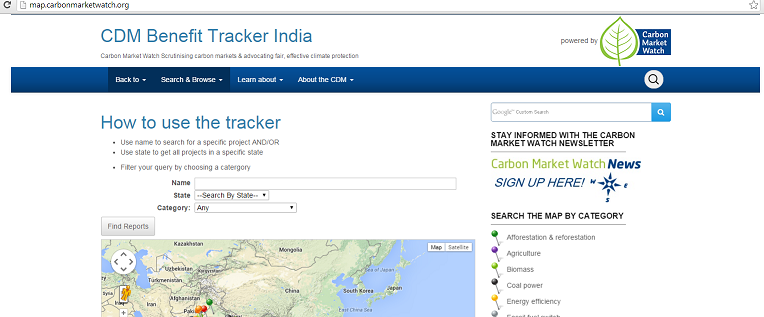
In Lima, Carbon Market Watch together with local Indian launched the ‘CDM Benefit Tracker India’, an interactive map that compares the sustainable development objectives outlined in CDM project application documents with eye witness accounts from local communities. Project owners have now been invited to comment on the results that find severe discrepancies between claims and local realities.
The event “Pitfalls Of Hydropower Project To Meet Climate And Sustainability Objectives”, held at the COP20 Mountains and Water Pavilion, gave participants the opportunity to listen to first hand experiences of affected communities in Guatemala, Panama and Colombia.
Brussels/Lima 8 December 2014, today the ‘CDM Benefit Tracker India’ will be launched in Lima, Peru. The Tracker compares eye witness accounts of local communities with sustainability objectives of CDM projects and finds severe discrepancies between claims and local realities. Local groups are now calling on countries in Lima to establish monitoring and verification provisions …
Read more “Press Advisory: Carbon Offsetting Benefit Tracker launched to showcase local reality of CDM projects”
The current global development framework, the Millennium Development Goals (MDGs), expires at the end of 2015 and will be replaced by the post-2015 global development framework, which will include a set of new Sustainable Development Goals (SDGs). As climate change poses a critical challenge to the post-2015 agenda, its adequate inclusion across the post-2015 framework is of key importance to step on a development pathway capable of minimising both the contribution to, and impacts from climate change over development efforts.
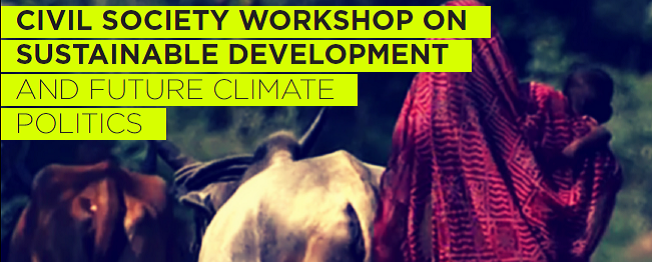
From 7-9 October 2014, Carbon Market Watch together with civil society organizations in India organized a workshop on sustainable development and future climate politics. Co-organizers included: Bank Information Centre, Beyond Copenhagen Collective, Christian Aid, Centre for Education and Documentation (CED), Centre for Environment, Social and Policy Research (CESPR), Center for Research and Advocacy – Manipur, …
Read more “Civil society workshop on sustainable development and future climate politics”