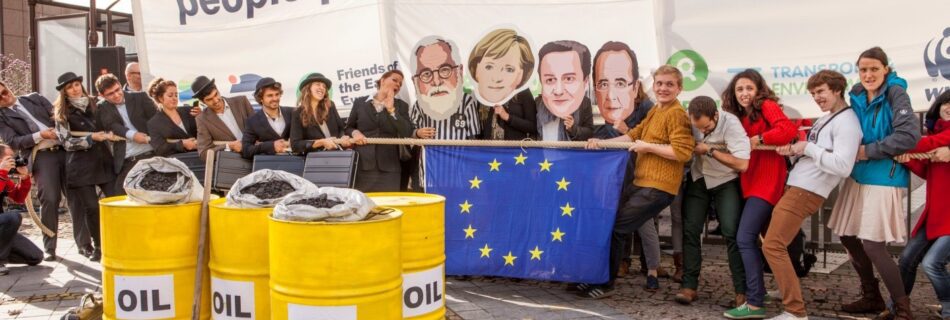
EU Environment ministers met in Brussels on 18 September to reach common positions on many of the key elements that they will be negotiating for at the UN climate talks in Paris in December.
A new study by the Stockholm Environment Institute (SEI) finds that bogus carbon offsets issued under the Kyoto Protocols’ Joint Implementation (JI) offsetting mechanism to date have increased global emissions by 600 million tonnes CO2 to date. The study came timely ahead of the ongoing round of climate talks in Bonn, concluding tomorrow, where countries need to work ensure that the new Paris climate treaty is not undermined, as Kyoto was, by hot air carbon credits.
With merely four weeks of negotiating time left before the conclusion of the Paris meeting to agree a new global climate agreement, the ongoing climate talks in Bonn that will conclude tomorrow, 4 September could either be a step forward or help bring about a needed step change in progress.
Climate change is a global injustice to present and future generations, and one of the greatest human rights challenges of our time. For one, climate change has a significant effect on several human rights, such as the right to safe and adequate water and food, the right to health and adequate housing, and the right to life. On the other hand, certain actions to address climate change can directly result in adverse impacts on human rights.
Introduction The Paris climate conference hopes to reach a new global agreement that will help to address anthropogenic climatic change. It has already been decided that this anticipated agreement will enter into effect in 2020. One of the most important issues for Paris will be the periodicity of Parties’ mitigation commitments, ie the length of …
Read more “Briefing Paper: The need for 5 year Commitment Periods in the Paris Protocol – Why a “review” is inadequate”
As a part of capacity building work on NAMAs, Carbon Market Watch organized a webinar on NAMAs and how civil society can contribute to and benefit from the process. The aim of the webinar was to build understanding among the civil society organisations (CSOs) on the functioning of NAMAs and the significance of public participation for accountability of NAMA actions. The speakers included representatives of civil society and United Nations Development Program (UNDP), who are developing and implementing NAMAs on the ground. During the webinar two case studies were presented – from Mexican and Georgian NAMAs – which highlighted the opportunities for and challenges from civil society engagement on the ground.
China has announced its Intended Nationally-Determined Contribution (INDC) to the global climate effort, meaning that the three largest emitters – the US, EU and China – have now put their opening bids on the table in advance of the Paris climate talks in December. While it is good that more countries have submitted INDCs, the …
Read more “China and others announce INDCs more Parties must follow suit”
During the first half of June, climate negotiators converged in Bonn for two intense weeks of negotiations. With only 6 months left before the Paris COP-21 Conference, negotiations towards the 2015 climate agreement constituted the most important work on-going during this session. But many other key aspects of international climate policy were also on the agenda in Bonn. Throughout these two weeks, negotiators unfortunately made little progress on three main questions to address in relation to the integration of human rights in climate policies.
Currently, parties to the UNFCCC are meeting in Bonn for a new round of climate negotiations. One of the topics that is on the table is the review of the Modalities and Procedures of the Clean Development Mechanism (CDM). Parties are thereby discussing rather “light” issues and shy away from more conflicting topics. But, when turning a blind eye on the necessity for more controversial themes, such as the establishment of a grievance mechanism, the review of the Modalities and Procedures may fall behind its great potential to improve the CDM for the future.