While Europe is trying to get its emissions trading system (ETS) out of the doldrums, China is busily preparing to launch its national carbon market. By 2020, China’s carbon market will have surpassed the EU ETS as the world’s largest carbon market, covering around 3 to 4 billion tonnes of CO2. South Korea, which in …
Read more “Capping the Dragon: prospects for Chinese and European emissions trading linkage”
On 24 September the European Parliament’s Environment committee, voted down an objection to the European Commission’s new carbon leakage list, 34 to 30. The objection was lodged by Green MEP Bas Eickhout and argued that the proposed €30 per tonne carbon price, used in determining which sectors are placed on the list, was grossly inflated. …
Read more “Carbon leakage: a blank cheque to industry”
On 23 and 24 October 2014, EU’s Heads of State will determine Europe’s future action to avoid dangerous global temperature rise. At this important date, it is expected that they will propose to reduce Europe’s domestic greenhouse gas emissions by 40% below 1990 levels by 2030. Of course, this proposed target is not nearly enough …
Read more “4 billion tonnes of hot air in the EU could turn the proposed 40% climate target into merely 26%”
Questions over how the potential risk of “carbon leakage” will be addressed in the 2030 climate and energy framework have recently gained importance. The discussions should ideally draw from the lessons learnt from the current carbon leakage provisions. This short media briefing shows that while there has been no evidence detected for the occurrence of carbon leakage so far, the European Commission has proposed to continue over-subsidising polluters at the expense of taxpayers.
“Dynamic allocation” – an industry model for windfall profits from free emission allowances at the expense of taxpayers The EU Emission Trading System (EU ETS) covers just over 40% of the EU’s greenhouse gas emissions from the industry and power sector. After each year, companies participating in the system must surrender enough allowances to cover …
Read more “Carbon Leakage Rebuttal”
Carbon leakage is the situation in which, as a result of stringent climate policies, companies move their production abroad to countries with less ambitious climate measures, which can lead to a rise in global greenhouse gas emissions. In Europe, the EU Emission Trading System (EU ETS) covers the greenhouse gas emissions from the industry and …
Read more “Carbon Leakage”
Read: Questions for stakeholder consultation on Emission Trading System (ETS) post-2020 carbon leakage provisions here Assumptions to be used for new EU ETS carbon leakage list 2015-2019 here Response to the consultation on Emission Trading System (ETS) post-2020 revision here
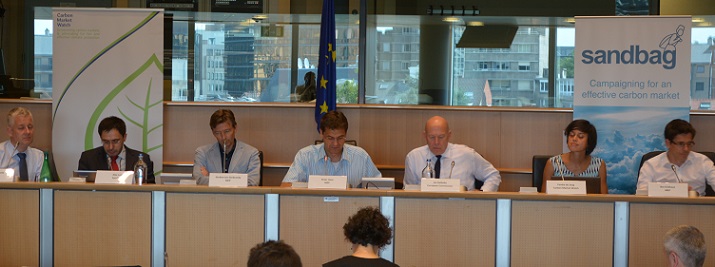
Tuesday 22 July 2014 from 15:00 to 17:00 European Parliament – Room JAN 6Q1 AN EVENT KINDLY HOSTED BY: Peter LIESE, EPP Matthias GROOTE, S&D Gerben-Jan GERBRANDY, ALDE Bas EICKHOUT, Greens/EFA The EU Emissions Trading System (EU ETS) is the largest carbon market in the world covering more than 11,000 power stations and industrial plants …
Read more “The EU Emissions Trading System: All You Need To Know About The World’s Largest Carbon Market”
Executive Summary The EU Emissions Trading System (EU ETS) is the largest carbon market in the world and was originally seen as the cornerstone of Europe’s climate policies. However, the EU ETS has suffered from a large amount of excess emissions allowances largely caused by weak emission reduction targets and the inflow of carbon offsets. …
Read more “Policy Briefing: What’s needed to fix the EU’s carbon market: Recommendations for the Market Stability Reserve and future ETS reform proposals”