The crisis facing the British steel industry has over the past week dominated front pages with the news that Tata Steel will sell all of its UK plants. Some have finger-pointed to the EU’s Emissions Trading System (EU ETS) as one of the reasons for the disarray in the steel industry, but analysis done for Carbon Market Watch and by others has shown that the steel sector in Europe has in fact benefited from EU’s climate policies.
This policy brief interprets the findings of a new study by CE Delft that shows how energy-intensive companies in Sweden have massively profited from their pollution to the count of €700 million because they are deemed to be at risk of “carbon leakage”. “Carbon leakage” refers to a hypothetical situation where companies transfer production to countries with weaker climate policies in order to lower their costs. Under the current EU Emissions Trading System (EU ETS) rules, industrial companies that are believed to be at risk of “carbon leakage” are awarded free pollution permits.
This policy brief interprets the findings of a new study by CE Delft that shows how energy-intensive companies in the Netherlands have massively profited from their pollution to the count of €1 billion because they are deemed to be at risk of “carbon leakage”. “Carbon leakage” refers to a hypothetical situation where companies transfer production to countries with weaker climate policies in order to lower their costs. Under the current EU Emissions Trading System (EU ETS) rules, industrial companies that are believed to be at risk of “carbon leakage” are awarded free pollution permits.
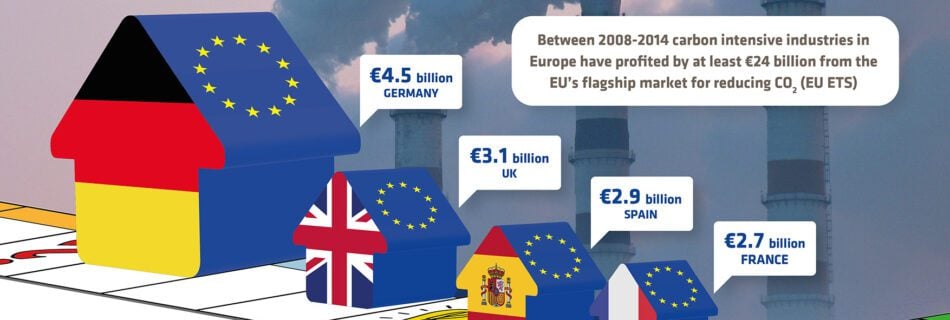
This policy brief interprets the findings of a new study by CE Delft that shows how energy-intensive companies in Germany have massively profited from their pollution to the count of €4.5 billion because they are deemed to be at risk of “carbon leakage”. “Carbon leakage” refers to a hypothetical situation where companies transfer production to countries with weaker climate policies in order to lower their costs. Under the current EU Emissions Trading System (EU ETS) rules, industrial companies that are believed to be at risk of “carbon leakage” are awarded free pollution permits.
This policy brief interprets the findings of a new study by CE Delft that shows how energy-intensive companies in France have massively profited from their pollution to the count of €2.7 billion because they are deemed to be at risk of “carbon leakage”. “Carbon leakage” refers to a hypothetical situation where companies transfer production to countries with weaker climate policies in order to lower their costs. Under the current EU Emissions Trading System (EU ETS) rules, industrial companies that are believed to be at risk of “carbon leakage” are awarded free pollution permits.
Brussels, 15 March 2016: New analysis shows how industry across Europe has earned a €24 billion windfall from 2008 to 2014, under the EU Emissions Trading Scheme (EU ETS). This is the main policy used across the EU to “cost-effectively”[i] reduce CO2 emissions across industry. The findings in a report ‘Calculation of additional profits of sectors and firms from the EU ETS’, from independent environmental analysts CE Delft, adds momentum to calls from MEPs and campaigners for an overhaul of the policy ahead of the negotiations to revisit the ETS rules this year at EU level.
This policy brief interprets the findings of a new study by CE Delft that shows how energy-intensive companies in 19 European countries have massively profited from their pollution because they are deemed to be at risk of “carbon leakage”. “Carbon leakage” refers to a hypothetical situation where companies transfer production to countries with weaker climate policies in order to lower their costs. Under the current EU Emissions Trading System (EU ETS) rules, industrial companies that are believed to be at risk of “carbon leakage” are awarded free pollution permits.
A key consideration for the Paris treaty is how to incentivize real additional climate action while avoiding the laundering of bogus hot air credits. Under the Kyoto Protocol the lack of environmental integrity in market mechanisms has resulted in an 11 gigatonne hot air loophole. These hot air units are called AAUs which will not pose a problem for the Paris climate treaty since they cannot be used after 2020. However, the fate of the hot air units of existing domestic emissions trading systems still hangs in the balance.
24 November, 2015 3-4.30pm CET (Brussels) Description: Despite the domestic mitigation targets expressed by most developed countries in their INDCs, some countries, such as the EU, have expressed interest in using carbon markets under the Paris agreement. This event will discuss the potential role of carbon markets post-2020 and will focus on the impact of …
Read more “Webinar – Role of carbon markets under the Paris climate treaty and impact on EU’s climate policies”