Europe is the fastest-warming continent on the planet, yet while citizens are suffering from heatwaves and the forests around them burn in catastrophic wildfires, the European Commission has proposed to weaken its flagship climate policy by allowing polluters to offset a quarter of a billion tonnes of CO2e with risky carbon credits – wasting billions of euros in the process.
The European Commission’s proposal to revise its flagship climate policy, the EU Emissions Trading System (ETS), includes an indirect integration of a whopping 260 million international carbon credits, at a moment when the Article 6 carbon markets from which these credits originate, are not delivering on their promises and before the EU has established its quality criteria to use such credits.
Although these credits would not directly enter the EU ETS, they still amount to offsetting, posing a significant risk to the bloc’s carbon pricing system. Concretely, the proposal allows for 260 million ETS allowances to be made available to a not-yet-established EU purchasing body, which would then auction these allowances and use the resulting funds to purchase international credits.
The introduction of credits lowers the ETS’s climate ambition, as it allows industries operating under the ETS cap to increase their emissions. The ETS cap sets the total emissions that industries covered by the system can collectively emit. In the proposal, this is presented as a euphemism: “creating emission space”. Some commentary has gone further, describing it as creating “breathing space” for industries, an almost satirical choice of words given what is actually at stake. Effectively, printing extra allowances to facilitate the purchase of these credits means the EU would be offsetting continued domestic emissions. Increasing the cap not only damages the credibility of the system and shifts the instrument off course from its necessary long-term emission reduction trajectory but it also weakens the intensity of its decarbonisation signal towards the industrial sectors it covers.
But just how much damage will 260 million credits cause?
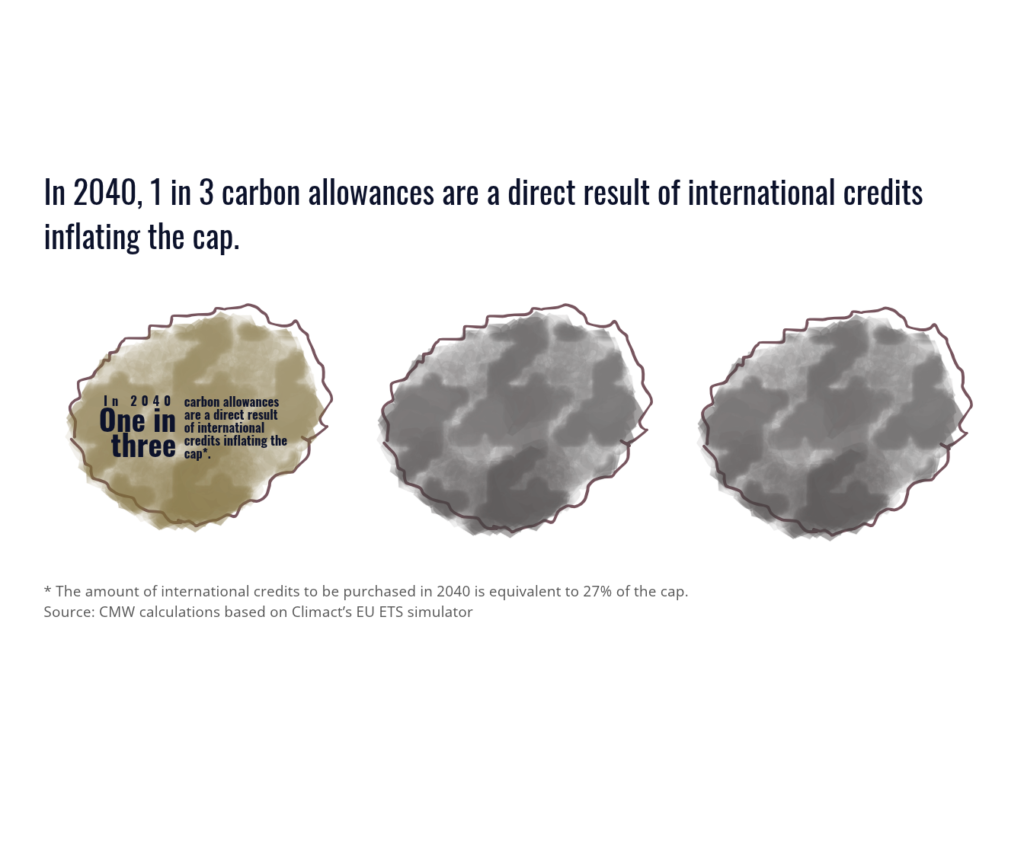
Short answer: a lot. The integration of credits will drive an increase of over a quarter of the emissions allowed under the ETS in 2040.
If carbon credits are excluded, the ETS cap drops to 237.3 MtCO2eq in 2040. This figure is based on our modelling using Climact’s EU ETS simulator, which predicts market trends across various market scenarios. Such a decision would have been in line with the EU’s ambition to reduce its emissions by 90% from 1990 levels by 2040. Under the current proposal, the integration of credits allows for the ETS cap to be increased to 324 MtCO2eq, limiting emission cuts to only 81%.
The difference in ambition between these two scenarios is substantial. A net 90% reduction target for 2040 compared to 1990 levels would have sat at the lower end of what the European Scientific Advisory Board on Climate Change recommends. Far from science-based, an 81% target effectively permits 90% more emissions in 2040 than the recommended 90% pathway. Moreover, the official EU advisory body has explicitly advised against using international carbon credits to meet the 2040 target.
The ETS proposal, in its current guise, unfortunately appears to indicate that the Commission intends to make full use of the international credits permitted under the revised Climate Law, which was officially adopted earlier this year. In doing so, it ignores the cautionary “up to” language of the Law, where the 5% value is presented as a maximum ceiling. It also disregards the demand from many member states to use international credits for their own national targets.
There is also an economic dimension to consider. The proposal allows for up to 260 million ETS allowances to be auctioned for the purpose of raising funds to buy international credits. Using an average allowance price of €164 between 2036 and 2040 (a Carbon Market Watch calculation based on Carbon Pulse projections), this amounts to a staggering €42.6 billion that, could be spent on supporting vulnerable households and European businesses through the transition, rather than wasted on international credits.
Fool me once, shame on you; fool me twice, shame on me!
This proposal risks EU policymakers repeating past mistakes. In the early years of the EU ETS, carbon credits generated by the Clean Development Mechanism (CDM), the predecessor of today’s UN carbon credit market under the Paris Agreement, were integrated into the EU’s carbon market to allow companies to offset part of their emissions. This integration depressed carbon prices and delayed the decarbonisation of the bloc’s heavy industry.
Although the Commission’s proposal excludes direct integration of international credits into the ETS, thereby mitigating some of the downward pressure on the carbon price, it preserves an indirect integration method. This policy design choice is still a form of integration and creates a structural risk to the EU ETS. By allowing up to 260 million tonnes of ETS emissions to be offset through potentially dodgy hot air credits, it effectively pushes down the carbon price and increases emissions.
Putting the roof up before the walls
The decision to introduce credits into this key pillar of EU climate policy arrives at a moment when the EU has not yet defined the quality criteria for the credits it intends to buy, nor has established a governance system for acquiring them. If the proposal were adopted in its current version, it would entrench the EU with reliance on international credits to reach its climate target and set the bloc up for fixing low-quality criteria in order to access massive volumes of cheap credits. Such reliance should be considered risky and premature, as Article 6 market rules are not fit for purpose.
The fact that Article 6 rules do not guarantee good quality credits, and that many politicians and vocal polluters across the EU do not list climate as their top priority, substantially increases the risk that the EU would buy shoddy quality credits. Under Article 6, countries can define their own rules on credit quality, but the EU has not yet done so. While the revised EU Climate Law, adopted earlier this year, contains some initial language on quality that could be read as a step in the right direction, the EU has a track record of setting good principles on paper and then falling short when time comes to put them into practice.
Meanwhile, how the credits are used matters as much as their perceived quality. While the EU can and must only use the highest quality credits, ultimately, these still only serve to displace or delay urgent domestic emission reductions that must happen first.
A safety net for a risk that does not need to exist
The proposal includes a fallback mechanism that would be activated if, by 2033, the Commission finds that not enough high-integrity credits are available. In that case, the EU would revert to achieving its target without any offsetting. In practice, that would mean lowering the emission cap, and accelerating the requirement for industries to decarbonise under the cap.
This approach is akin to building incentives the wrong way round. It would have been better not to create this reliance in the first place: keep the ETS ambition intact, and only tweak it if high-quality credits actually materialise and are affordable.
Given the current majorities in the European Parliament and Council, trilogues risk weakening the Commission’s proposed criteria. On top of that, the fallback mechanism creates a perverse incentive to water down the criteria for credits as much as possible to ensure enough credits clear the bar. If not enough credits can be found, the ambition of the ETS automatically increases. That prospect creates an incentive to push for quality criteria loose enough to guarantee that the ratchet-up mechanism never needs to be activated. The approach we propose would instead remove this pressure to water down quality.
What now?
The 2040 target saga has exposed a litany of bad choices: weakening the 2040 emission reduction target’s ambition, further undermining its integrity with flexibilities such as international credits, and now watering down the EU’s core policy instrument to drive down emissions.
The course that’s being charted is unacceptable: EU institutions must, and critically still can, do better. And after an excruciating summer, it’s obvious that citizens should be getting a breath of fresh air, not polluters.