While the US is seemingly ‘participating’ in CORSIA, it has shown no interest in enforcing rules that make its airlines pay – and there is no reason to expect that to change. The EU can no longer afford to wait while the world’s largest aviation markets do nothing. Expanding the EU ETS to all departing EEA flights, including those operated by US airlines, is crucial to generate much needed revenue and spark aviation’s green transition.
The Carbon Offsetting and Reduction Scheme for International Aviation (CORSIA) was supposed to address emissions from international flights, including those to and from Europe. But it’s clear the scheme is deeply flawed, suffering from patchy enforcement, limited coverage, and reliance on low-quality offsets instead of real emission cuts.
Recent actions – and inactions – in the United States make it clear that CORSIA is a phantom scheme, unlikely to ever get off the ground. While the US is seemingly ‘participating’ in CORSIA, it has made no commitment to move beyond the voluntary phase or shown any interest in making its airlines pay.
Meanwhile, the European Union has been waiting for global aviation pricing to take-off as its own emissions reducing scheme – the Emissions Trading Scheme (ETS) – sits patiently in the departure lounge. As the bloc’s biggest trading partners avoid carbon pricing responsibilities the EU must wait no longer, and extend pricing to all departing EEA flights, including those operated by US airlines.
Low cost airlines
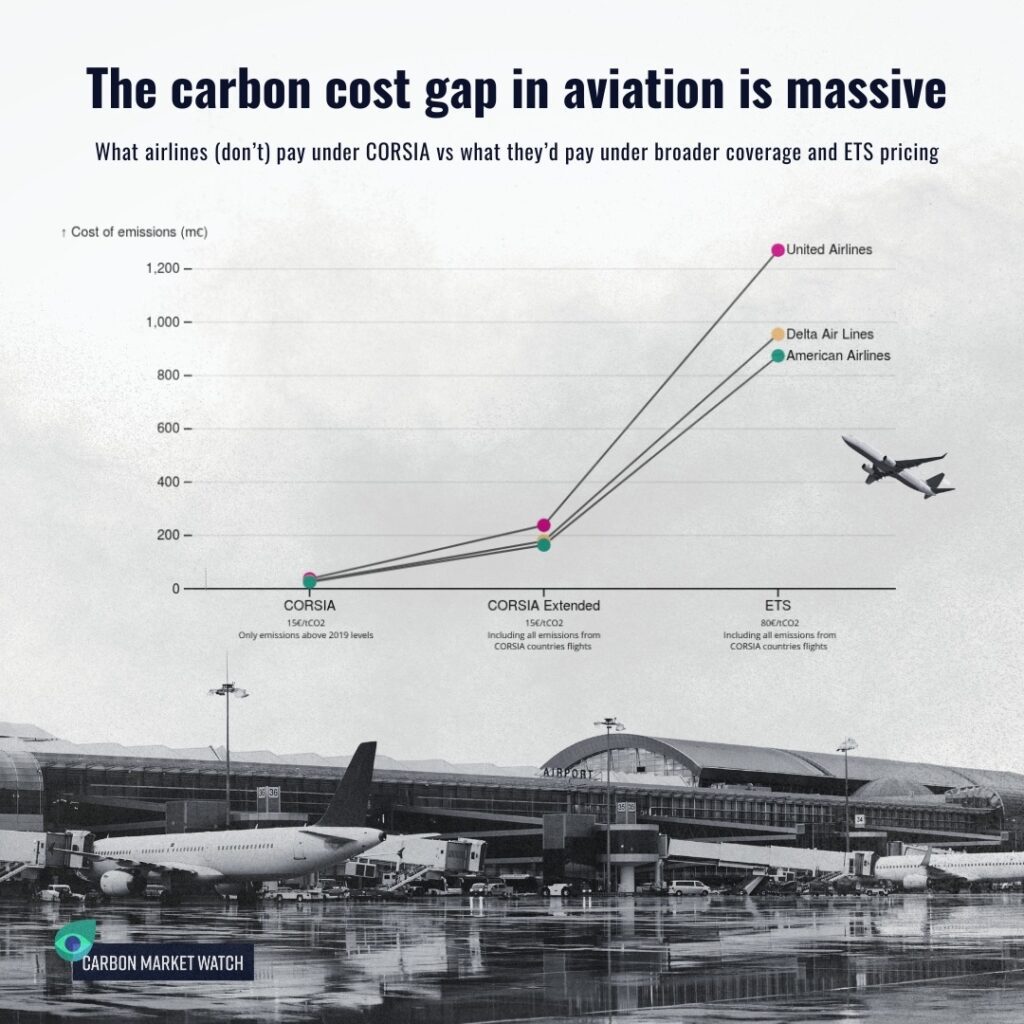
Using public emissions data from the International Civil Aviation Organisation (ICAO) and based on the recent average credit price of $15 per tonne of CO2, calculations by Carbon Market Watch show US airlines would be asked to pay $126.9 million for their 2024 emissions under CORSIA. The biggest payers: United ($36.7M), Delta ($27.6M), and American Airlines ($25.2M).
While at first glance these multi-million costs may appear significant, the numbers are very low relative to what US airlines should be paying for their carbon pollution. CORSIA applies only to flights between participating countries and only on emissions produced above a high baseline set at 85% of 2019 emissions. If all emissions from CORSIA-covered flights were included, instead of just the growth of the sector, the bill would balloon to a total of $824 million.
And because airlines have a habit of offsetting their emissions using cheap, low-quality carbon credits that do not deliver the emissions reductions they claim, the CORSIA scheme is a long way short of what could be considered appropriate climate action.
If the scheme applied the average $80/tCO2 price of the EU ETS and covered all carbon emissions – not only those exceeding the 85% CORSIA baseline – US airlines’ 2024 emissions would have generated a staggering $4.39 billion in revenue. Forty times more than what they were actually asked to pay by CORSIA. Even this ‘full-cost’ estimate, however, remains incomplete: it excludes contrails, whose climate-warming effect can be up to three times higher than that of carbon emissions alone.
That is a colossal amount of foregone revenue that could have been used to support cleaner technologies that cut emissions at source, rather than compensating them through low-quality offsets.
Even small payments are unlikely
In practice, US airlines are unlikely to pay even the miniscule $126.9 million for their 2024 emissions from CORSIA-covered flights. The global airline lobby, the International Air Transport Association (IATA), recently suggested it would be ‘force majeure’ if the credit supply is too low (and prices are too high).
This position is consistent with IATA’s broader track record: while it publicly proclaims the industry’s commitment to net-zero emissions by 2050, it has systematically and repeatedly opposed policies that would bind airlines to emissions reductions.
By revenue, American Airlines, Delta, and United are the biggest airlines globally and the most influential IATA members. There is no reason to believe that the biggest US airlines will buy CORSIA credits under their own initiative, while the Trump administration is unlikely to push them into action by imposing CORSIA penalties that would only come into effect after a country implements them into national law.
Several factors make it clear that US enforcement of CORSIA is extremely unlikely:
- The US has not committed to the scheme beyond voluntary phases.
- The US has stated explicitly that it will not act until major aviation markets (like China and India) – which have shown no interest in participating in CORSIA – buy into the scheme.
- The Trump administration has threatened other countries with sanctions for supporting a similar global measure addressing shipping emissions – the IMO Net-Zero Framework.
- Four of the largest US airlines are expected to pay an additional $11 billion for jet fuel this year because they stopped locking in fuel prices in advance – a practice known as hedging – a decade ago. This left them exposed to the sharp rise in fuel costs ignited by the US-Israel war against Iran.
Europe shouldn’t wait
Although the US won’t enforce CORSIA, that is no excuse for the EU to hold back its own carbon pricing plans for aviation. Europe has its own tool – the EU ETS – but its coverage is incomplete, leaving the international routes causing most pollution outside its scope. For example, if Delta’s flights to and from the EEA were covered in 2024, the EU would have gained over €200 million (at €80 per tonne), as these flights alone emitted more than 2.5 million tonnes of CO2.
Expanding the ETS to all flights that depart from the EEA would more than double existing revenues under the current intra-EEA scope, generating an additional €9 billion annually by 2030 and roughly €259 billion between 2025 and 2040. These revenues could then be invested in transport decarbonisation rather than low-quality offsets.
A scheme without enforcement is meaningless – it will simply be ignored. With US airlines facing absolutely no repercussions for skipping CORSIA costs, the EU has a strong justification to extend the ETS to all departing flights.
Pricing international flights is not just an option – it’s a responsibility, essential to raise much needed revenue and cut emissions.