
In the difficult negotiation process surrounding the EU Emissions Trading System (ETS), one of the most contentious points for member states and Members of the European Parliament is determining whether or not the recently proposed ETS revision will enable the EU to reach its established emission reduction goals. Research from Öko-Institut and Climact suggests this aim will not be reached: the carbon market risks being flooded with allowances, while decarbonisation efforts are unloaded onto non-ETS sectors.
European Union member states will now be allowed to rely on international carbon credits to meet their 2040 climate targets. While the bloc’s flagship target remains a 90% net emissions reduction compared to 1990, a March 2026 amendment to the European Climate Law allows capitals to limit domestic cuts to 85% and cover the remaining balance of up to 5% through international carbon credits.
During the ongoing revision of the EU’s flagship climate policy, understanding the implications of the Emissions Trading System 1 (EU ETS1) for the European reduction targets is key to determining how targets for non-ETS1 sectors should be set. Yet, progress on emissions reductions will occur at two different speeds. In 2005, domestic emissions under the EU ETS1 accounted for around 50% of the EU-27’s total net emissions. In 2024, that dropped to 38%, a 50% reduction since 2005, while sectors covered by the Effort Sharing Regulation (ESR) have achieved a less impressive 20% reduction since the same year.
Modelling from Climact estimates that the Commission’s 17 July proposal to revise the ETS might under-deliver towards the EU’s domestic climate target and that significant effort would pass to non-ETS sectors, such as agriculture.
Climact’s simulator puts the ETS1’s own domestic reduction at around 81% against a 2005 baseline, which would require ESR sectors to reach close to a 78% domestic reduction over the same period to keep track with the economy-wide target of 85%. However, this scenario relies on millions of international credits, from a market that is currently not delivering its promises.
A scenario where international credits contribute to 2% of the reduction would require an ESR target to climb substantially to 83%, a rate even more ambitious than the ETS sectors. Climact estimates that such a steep ESR target is unrealistic. ESR sectors achieved reductions of only 20% between 2005 and 2024: this means that to adapt to the current ETS proposal, ESR sectors would need to slash emissions by a factor of four times faster than in the past, relative to the previous 20 years since the ETS commenced operation.
What is the cap capping?
The Emissions Trading System (EU ETS) is a cap-and-trade system that aims to limit emissions of the power, industrial, aviation and maritime sectors. The cap sets an annual limit on the supply of new pollution permits that installations covered by the system will need to cover their emissions. The emission reduction target is achieved by a constant decrease in this cap. The cap decreases linearly, following the so-called Linear Reduction Factor (LRF), which is expressed as a percentage of the 2013 total cap.
The LRF has changed significantly since the system began. From 2013 to 2020, the LRF was set at 1.74% (around 34 million carbon permits per year), then at 2.2% as of 2021, 4.3% from 2024 to 2027, and 4.4% from 2028 to 2030. A small change to the LRF significantly impacts the amount of emissions allowed in the system.
CMW analysis shows that since 2013, emissions of the industry, power and maritime sectors have never exceeded 86% of the cap. This leads to a question: what exactly is the cap capping?
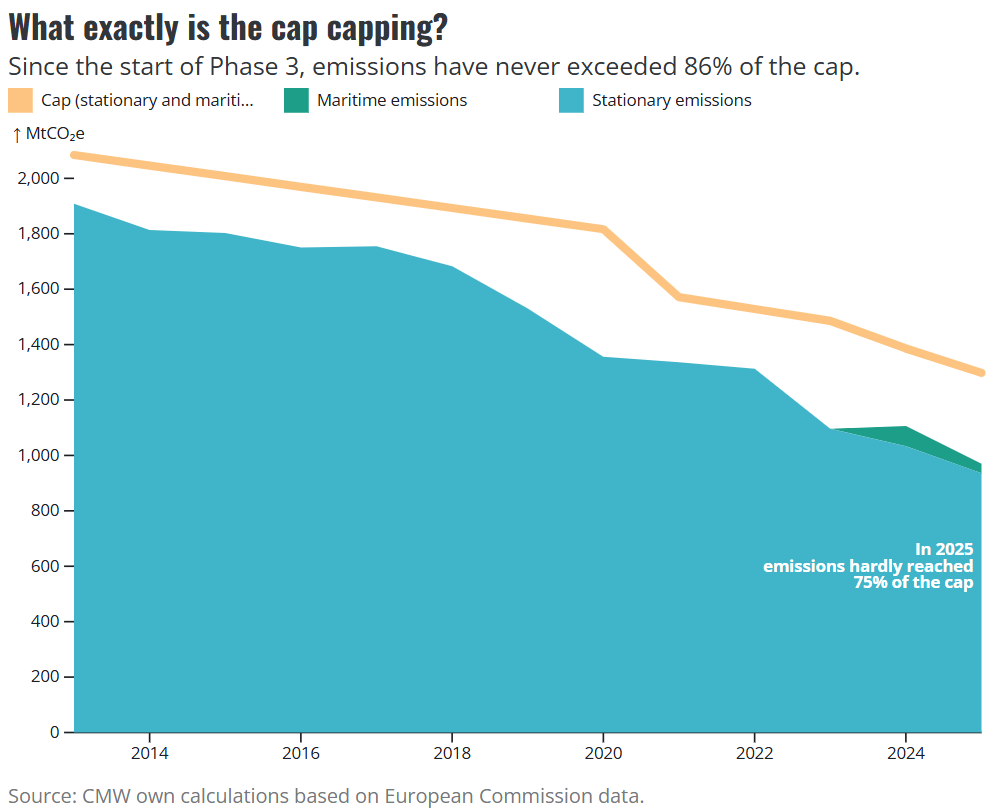
Rather than tightening the cap to absorb this surplus, the Commission’s new proposal tilts in the opposite direction, attempting to loosen the cap even further by substantially reducing the LRF. The proposed LRF is set at 3.7% for the period 2031–2035 and flattens to 1.7% from 2036 onwards, setting the LRF at a lower rate than it was more than a decade before.
Based on CMW calculations, this retrograde action alone will add two billion metric tonnes of CO2 to the allowable emissions under the cap for the power, industrial and maritime sectors, representing an additional 67% of the allowable emissions following the current trend and stretching the cap until 2048. However, when accounting for the combination of the different features proposed by the Commission (see below for more details), Climact estimated an additional 2.2 billion allowances compared to the status quo.
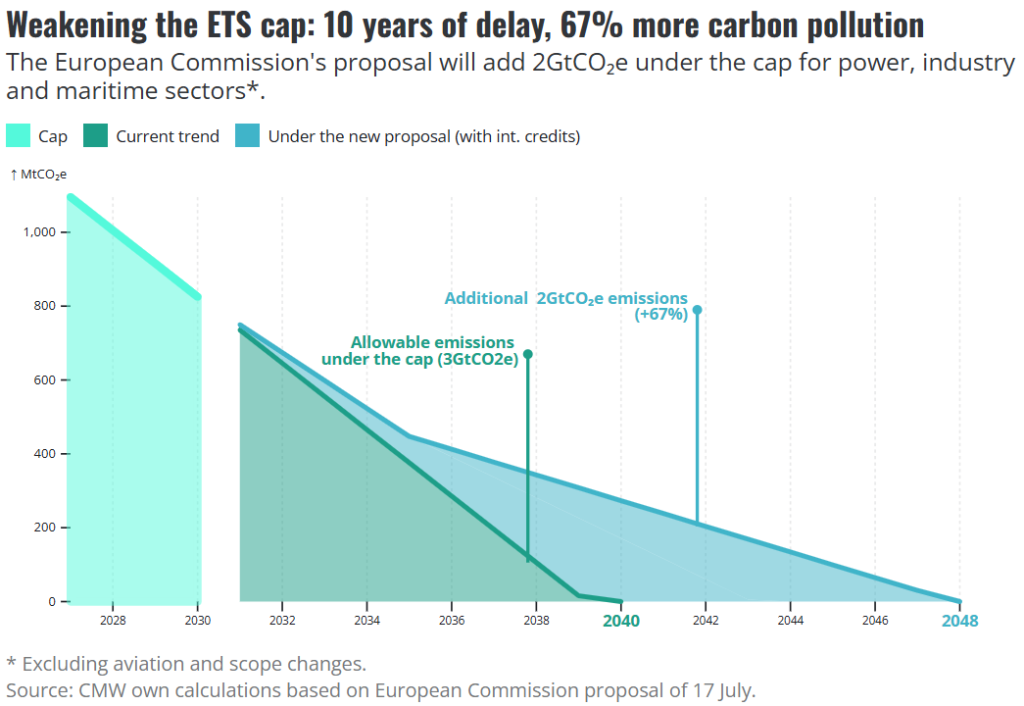
The proposal incorporates the planned purchase of 260 million international credits starting in 2036, reducing the European domestic abatement requirement in 2040 from 90% to 85%.
But the LRF change is not the only mechanism that increases the ETS1 carbon budget in the Commission’s proposal. The indirect integration of domestic carbon dioxide removals (CDR) into the system will further inflate the emittable tonnes of CO2, to fund permanent CDR projects. These emissions come on top of the cap, ballooning the overall carbon budget by another 250 million allowances from 2031 to 2040. This represents an additional 7% increase from the current trend.
Additionally, the ETS1 Market Stability Reserve (MSR1) is meant to be the system’s shock absorber, pulling allowances out of circulation when there’s oversupply and releasing them if the market were to eventually tighten. In April, the European Commission proposed substantially dismantling the core mechanism of MSR1: the invalidation clause which cancels allowances permanently when the Reserve breaches a set oversupply threshold. Although ongoing negotiations on this file indicate that the invalidation clause is highly likely to survive, a carbon bomb has been lit for the future that could still result in an additional 350 million allowances released on the market after 2035.
In combination, the weaker LRF, international credits, the inclusion of CDR and the carryover holdings in the MSR1 still don’t account for all potential sources of allowances, and therefore all the tonnes of CO2 that can possibly be emitted under the ETS system. There are millions of oversupplied allowances in circulation due to the system being structurally oversupplied in the past and present (the so-called TNAC, total number of allowances in circulation). And there is yet another pot of allowances that could reach the market in the next few years: the New Entrants Reserve (NER), put aside for new installation and new production capacity entering the ETS, sitting at over 300 million allowances according to the European Commission Carbon Market reports.
Extra room to pollute
Despite the uncertain outlook of the market due to the proposed rules, an independent assessment reached a similar conclusion: under the Commission’s proposal, the ETS would be significantly oversupplied by 2040, making it likely to miss the newly agreed climate target.
Öko-Institut estimates the entire oversupply over 2031-2040 at 1.9 billion EUAs, equivalent to 35% of total demand. Note that this doesn’t take the latest MSR1 negotiation outcomes into account, so it could potentially be about 350 million too high based on the progress of ongoing negotiations.
The supply-demand gap is significant enough for Öko-Institut to recommend that the LRF remain at 4.4% until at least 2035. This recommendation was also raised by Agora Energiewende, stressing that maintaining the current LRF trajectory until 2035 is crucial to create stability and investment certainty.
The lesson learned from the past two decades of the scheme is not that it needs more flexibility, but that the flexibility that has been accumulated for years with banked surplus and allowances handed out for free goes against the system’s core objective. Adding a further two billion tonnes of headroom and extending the cap does not fix that problem, it multiplies it. The ETS needs to stay on its pre-proposal trajectory to rapidly limit the EU’s vulnerability to international fossil fuel markets (and the climate disasters those fossil fuels cause).
Room to pollute, room to fail
Taken together, these findings describe a single mechanism working at two dysfunctional levels. Inside the ETS1, a persistently loose cap blunts the price signal that’s supposed to drive industrial decarbonisation. Outside the ETS1, this leniency creates spillover pressure on the ESR sectors.
Twenty years into the EU ETS, the same evidence continually reappears: the system keeps handing out more room than the market needs. Emissions have never reached close to the cap since 2013, and independent modelling demonstrates that the Commission’s proposal would only stretch that slack further, oversupplying the market well into the 2040s and blunting the price signal the ETS depends on to drive decarbonisation.
The EU’s 2040 climate target is at risk. Every extra billion tonnes of headroom is a billion tonnes of decarbonisation the ETS won’t deliver, and that needs to be reduced from other polluting sectors.
However, EU policymakers now have the chance to not only keep the ETS on track, but to raise the standard for the bloc’s flagship climate policy. The LRF must remain at 4.4% through at least until 2035, avoiding any regression to levels seen more than a decade ago. The MSR’s absorption and cancellation functions must be maintained, not weakened. And crucially, carbon removals should be kept out of ETS to keep the carbon market laser-focused on emissions reduction.