
What does proposed EU 2040 target mean for climate action?
The European Commission’s unambitious proposed climate target for 2040 risks becoming riddled with loopholes and delaying urgent climate action. This in-depth analysis explains how and why.

The European Commission’s unambitious proposed climate target for 2040 risks becoming riddled with loopholes and delaying urgent climate action. This in-depth analysis explains how and why.

Carbon Market Watch has joined 21 NGOs, trade associations, and businesses in a joint call for the inclusion of waste incinerators and landfills in the EU ETS. This initiative aligns with the EU ETS public consultation process, which will run until 8 July 2025, ahead of the legal review by the Commission due by July 2026.

A new report reveals that cookstove carbon projects eligible for the Korean Emissions Trading System are at risk of issuing 18 times more credits than they should, echoing past EU carbon market mistakes

CMW commissioned environmental consultants Ricardo to produce this study comparing the functioning of the EU ETS and CORSIA, and their respective climate ambitions.

In response to a European Commission consultation, CMW outlined its view on the role of permanent carbon capture and utilisation in the EU’s Emissions Trading System.
BAH, HUMBUG! END €TS FREEBIES. MAKE POLLUTERS PAY FOR A FAIR AND CLEAN TRANSFORMATION
This week, the rapporteur of the European Parliament’s Environment committee (Ian Duncan) published his draft report on the EU’s carbon market reform, kicking off the legislative debate. Disappointingly, the proposal fails to address the most pressing issues that need fixing in order to make the EU ETS fit-for-purpose and in line with the Paris climate agreement.
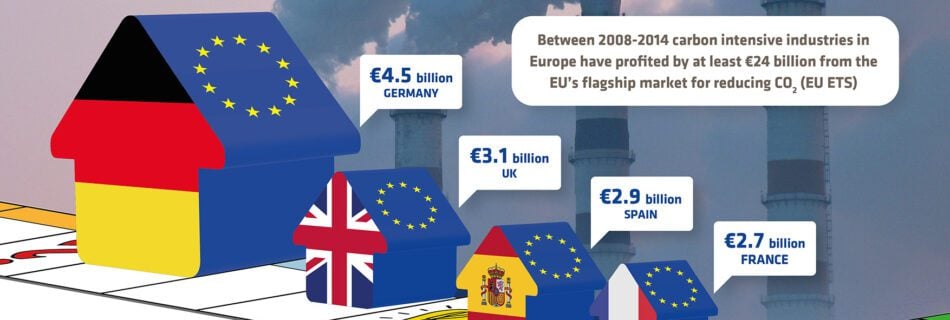
This policy brief interprets the findings of a new study by CE Delft that shows how energy-intensive companies in 19 European countries have massively profited from their pollution because they are deemed to be at risk of “carbon leakage”. “Carbon leakage” refers to a hypothetical situation where companies transfer production to countries with weaker climate policies in order to lower their costs. Under the current EU Emissions Trading System (EU ETS) rules, industrial companies that are believed to be at risk of “carbon leakage” are awarded free pollution permits.
The concept of “carbon leakage” is a major area of discussion in the legislative proposal to revise the EU’s Emissions Trading System (EU ETS) for the post-2020 period. The Commission’s proposal continues the trend of awarding free allowances, effectively representing a financial subsidy of €160 billion, to heavy emitters without providing evidence for the need of such beneficial treatment. A new Carbon Market Watch policy brief “Carbon leakage myth buster” shows how certain manufacturing companies have profited from selling the free EU ETS allowances they were given and recommends how to avoid such windfall profits in the future.