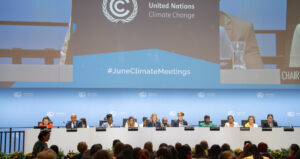
November 16, 2026 | Antalya: A push to deregulate the Paris Agreement’s international carbon-crediting mechanism is emerging at COP31, with several countries calling for weaker rules, arguing that existing requirements are too stringent and threaten the mechanism’s economic viability.
Climate, human rights, and workers’ organizations warn that simplifying the rules in the name of economic efficiency risks putting profits ahead of people and the environment. Weakening safeguards for environmental integrity, communities, territories and ecosystems will repeat the failures of earlier carbon markets, undermining human rights, labor rights and the credibility of climate action.
Deregulation is not a substitute for genuine climate action, which is needed now more than ever as the world is on the brink of permanently breaching 1.5C. The rules are supposed to be reviewed in 2028; but governments and industry are trying to circumvent the normal process. Governments must reject any COP31 guidance that lowers existing standards or protections for people, nature and the climate.
Read below the reaction from civil society and worker representatives on the current development.
Isa Mulder, Policy expert at Carbon Market Watch:
“The whole purpose of Article 6 is to help countries achieve the Paris Agreement 1.5°C temperature goal, not to guarantee the profits of carbon credit developers.
Having a Paris Agreement carbon crediting mechanism that cheats the atmosphere completely misses the point. Prioritizing economic feasibility over environmental integrity is putting the cart before the horse. Countries should not allow Article 6 to become just another dangerous distraction from real, urgent climate action.”
Erika Lennon, Senior Attorney at the Center for International Environmental Law (CIEL US):
“As the world edges ever closer to breaching the 1.5°C temperature limit, any attempt by a State to weaken the rules of the Paris Agreement’s carbon market is utterly unacceptable.
“Carbon offset markets have a long track record of failing to deliver real climate action while contributing to human rights abuses, land grabs and the marginalization of communities. Why should countries allow these failures to continue, let alone weaken the safeguards designed to prevent them, especially in the face of escalating climate breakdown?
“Weakening the rules is not climate ambition. It is a license to pollute. It would put fossil fuel interests ahead of human rights, communities and the planet, while undermining the integrity of the Paris Agreement itself. We cannot afford to turn the carbon market into another loophole for polluters. The rules must be strengthened and upheld, not dismantled.”
Hwei Mian Lim, Article 6 co-lead of the Women and Gender Constituency:
“The watering down of rules and safeguards in PACM is a no-go zone. The recent texts proposing that “further developing, approving and revising standards, methodologies and tools” need to avoid over conservativeness; and that PACM should draw from REDD+ methodologies are red flags. Recurring issues from REDD+ projects are well-documented such as reversals, non-permanence, leakage, additionality, and violation of the rights of Indigenous Peoples and local communities, including women who are protectors, users and defenders of the customary forests.”
Rárisson Sampaio, Policy Adviser for environmental justice and energy transition at the Institute for Socioeconomic Studies (Inesc, Brazil)
“Past experiences with carbon market projects have shown that they have weaknesses and inconsistencies which have led to human rights violations and have contributed little to effective climate action. In Brazil, for instance, many indigenous communities and small farmers were affected by harmful carbon market projects. This mitigation model must be strengthened with more robust socio-environmental safeguards, effective community participation and benefit-sharing. This runs counter to the proposals presented at COP31, which seek to weaken the mechanism set out in Article 6.4 of the Paris Agreement by putting the power in the hands of market actors.”
Emmanuel Patola, Article 6 co-coordinator of the TUNGO constituency
“Article 6 should focus on ensuring there are robust labor, environmental, and human rights safeguards.
Profits of big corporations should not take over environmental integrity rules that are needed to ensure that the PACM doesn’t worsen climate change and further marginalize workers and their communities.
Workers underpin all stages of carbon markets but are invisible. So far, there is an absence of standardized reporting on wages, workplace safety, and collective bargaining rights. We need stronger rules to protect people.”
Contact: [email protected]