Ahead of COP 31, this must-read explainer analyses what the Article 6.2 Technical Expert Reviews published to date reveal about countries’ carbon trade reporting, concluding there’s plenty of work to do in Antalya.
What is a Technical Expert Review?
The Article 6.2 Technical Expert Review (TER) process serves as an important, if not the only, centralised checkpoint to help those following the UN’s carbon market gauge the social and environmental integrity of Article 6.2 cooperative approaches.
In this process, a Technical Expert Review Team (TERT) reviews the Initial Reports that countries participating in Article 6.2 must submit in order to demonstrate that their cooperative approach – which is essentially the plan for carbon trading a country has – meets the reporting standards outset in the Article 6.2 rulebook. In completing this process, the TERT publishes a Technical Expert Review report for each cooperative approach analysed. This report contains both a summary and a detailed description of its findings across the different reporting requirements, and identifies whether any shortcomings in the reporting were found during the review, which are called inconsistencies in Article 6.2.
And what happens if an inconsistency is found?
If the TERT identifies an “inconsistency”, it means the country’s Initial Report failed to meet the transparency, accuracy, or completeness requirements on a given reporting element set out in the Article 6.2 guidance. Since COP 29 in Baku, the TERT has also had the task of, at its discretion, identifying a “significant” or “persistent” inconsistency and will explicitly highlight inconsistencies that directly affect how a Party accounts for its greenhouse gas emissions through its emissions balance. These additional categories – especially those considered to be significant inconsistencies or inconsistencies that affect the emissions balance – can broadly be understood as a red flag for the environmental integrity of the cooperative approach. Still, while an impact on the country’s emissions balance is worrying, it seems that other problematic issues – such as those related to how human rights are being upheld – cannot currently be classified by the TERT as significant inconsistencies.
Nevertheless, the TERs tell us a lot about the cooperative approaches, especially because they contain descriptions of their findings and recommendations to the country on each reporting element in the review’s so-called addendum. However, the issue is that these reviews are long and use highly technical, diplomatic language, making it difficult to parse exactly what the reviewers are saying.
This analysis aims to bring clarity to the main findings of completed reviews, especially where they have implications for the climate, or for the people on the frontline where Article 6 activities are being implemented.
The necessary trading foundations are absent
Building on our initial analysis of the first five Article 6.2 Technical Expert Reviews (TERs) published in 2025, this follow-up analysis includes all TERs published to date, including the second set, published in 2026. This review cycle covers the Initial Reports of one buyer country, Japan, and nine host countries: Sri Lanka, Maldives, Mongolia, Palau, Tunisia, Cambodia, Malawi, Rwanda, and Zimbabwe. For Japan, two Initial Reports were published and reviewed. For the purpose of this analysis, only the updated Initial Report and its review were taken into account.
Taken together, these 15 reviews show that, across the board, the necessary foundations for international carbon credit trading are absent from reporting. This ranges from shortcomings in basic infrastructure to deficiencies in critical aspects of reporting such as environmental integrity and human rights.
It must be noted that while significant inconsistencies can allude to the severity of an inconsistency, this terminology was not yet applied across the first five TERs; thus, no inconsistencies were classified as significant for Switzerland, Thailand, Ghana, Vanuatu, and Guyana. It is possible that inconsistencies found in their reporting would, under the current framework, be characterised as significant.
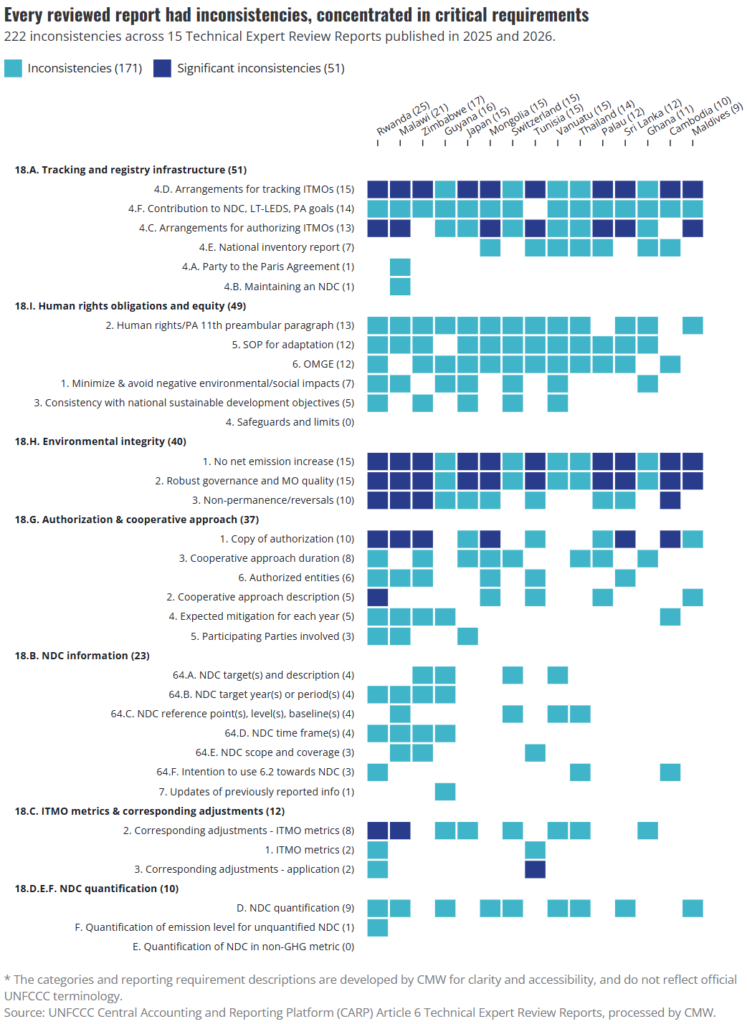
Across all 15 published Technical Expert Reviews (TERs) analysed, every reviewed Initial Report was found to contain reporting inconsistencies. On the reporting requirements regarding tracking and registry infrastructure (18.A), no net increase in global emissions (18.H.1), and conservative baselines & governance (18.H.2), all countries were found to have inconsistencies. On the reporting requirements for arrangements for authorising ITMOs (18.A/4.C), contributions to NDCs, LT-LEDS and the Paris Agreement long-term goals (18.A/4.F), and respect for human rights and social safeguards (18.I.2), all but one or two countries had inconsistencies.
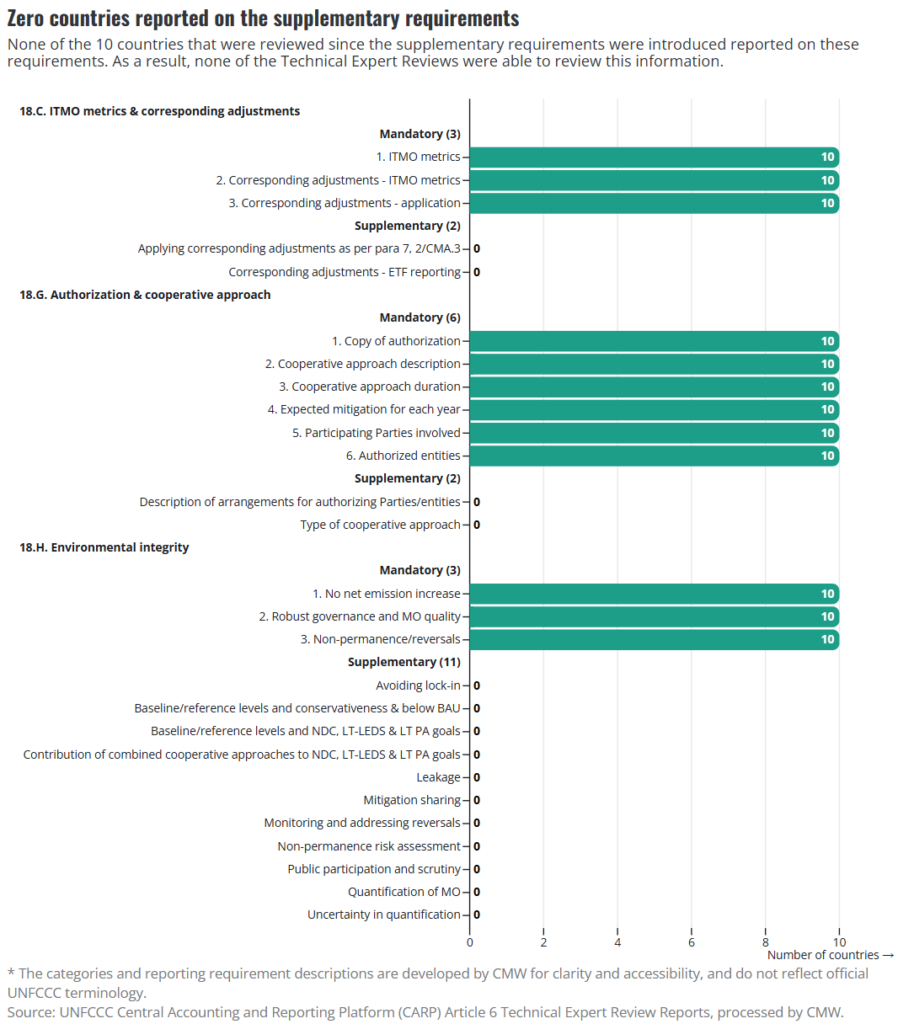
In 2024 at COP29 in Baku, additional reporting requirements were added to several categories of the Initial Report. These requirements did not yet apply to the countries reviewed in 2025, but they are part of the 2026 review round. However, none of the countries reviewed in 2026 have reported on these additional requirements. This is especially concerning as these additional elements contain crucial questions to judge the quality of the cooperative approach and its benefits for the climate, such as how a cooperative approach avoids lock-in of emissions, how mitigation outcomes are shared between the participating countries, and how decision-making is ensured to be transparent and inclusive and allows for public participation and scrutiny.
To see what the inconsistencies mean in tangible terms and why this is important, we will look at two critical impact areas of Article 6.2 cooperative approaches for people and the planet: environmental integrity and human rights.
The logic gap in reporting environmental integrity
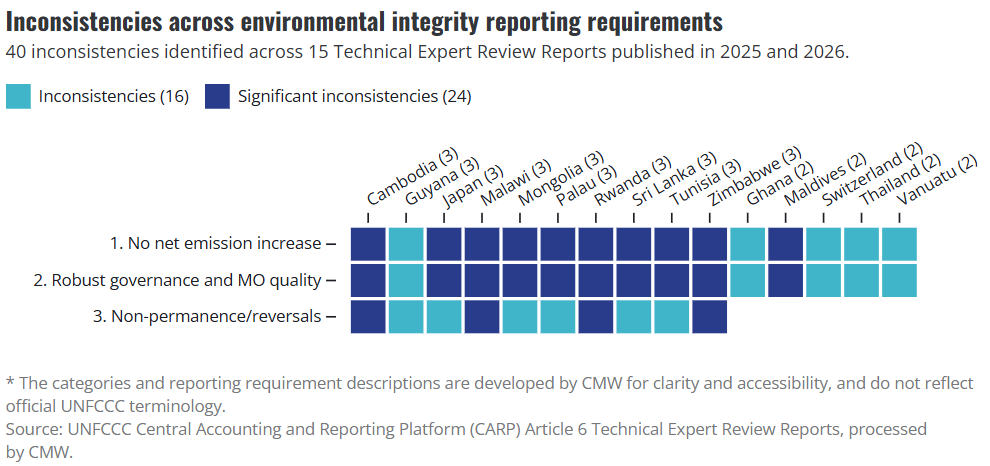
All reports were found to be insufficient in providing transparent rationales to ensure that no net increase in global emissions would occur (18.H.1). Sri Lanka, Mongolia, and Maldives argue that applying corresponding adjustments was sufficient to prove no net increase. In response, the TERT has stated that accounting is not a substitute for methodology and demands transparent disclosure of “methods, assumptions, and rationales” to demonstrate that the activity itself is rigorous, rather than merely correctly accounted for. The logic of the TERT is clear: corresponding adjustments are an accounting tool, not a mitigation tool. Simply applying a corresponding adjustment does not guarantee environmental integrity if the underlying credit is, for example, based on an inflated baseline.
Regarding how the cooperative approach ensures robust governance and quality of mitigation outcomes, including conservative baselines (18.H.2), inconsistencies were also found in all reports. Countries frequently cited general crediting standard guidelines (such as the JCM Guidelines for Developing Proposed Methodology, CDM small-scale methodologies, or ART TREES) in their reports, without providing specific descriptions of how quality was ensured. As a result, the review teams flagged inconsistencies on multiple occasions because critical information was missing, such as how reference baselines are conservatively set below business as usual (BAU), how existing national, subnational, or sectoral policies and legal mandates are factored into baseline calculations, and how potential leakage (emissions displaced outside project boundaries) and quantification uncertainties are identified, calculated, and deducted from credited mitigation outcomes.
Skating over human rights obligations and equity considerations
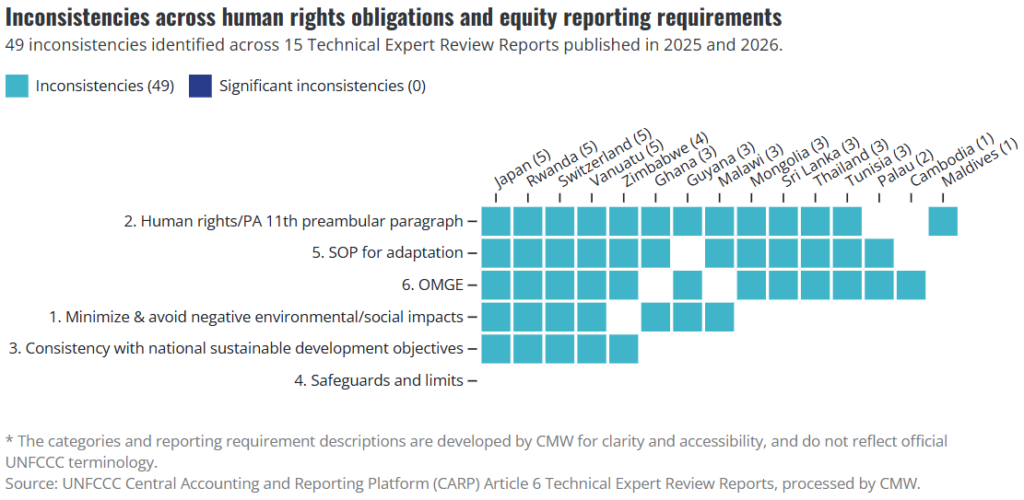
Under requirement 18.I.1, countries must describe how their cooperative approach will minimise and, where possible, avoid negative environmental, economic and social impacts. In addition, under requirement 18.I.2, countries must describe how their cooperative approaches reflect their obligations to respect, promote, and consider human rights, the right to health, the rights of Indigenous Peoples, local communities, migrants, children, persons with disabilities, people in vulnerable situations, the right to development, gender equality, empowerment of women, and intergenerational equity, in accordance with the Paris Agreement’s 11th preambular paragraph.
Many countries provided information covering only a single dimension of these requirements, such as gender guidelines (e.g., Japan, Mongolia, Maldives, and Sri Lanka citing the JCM Guideline on Gender Equality), or only provided general environmental and social screening tools (e.g., Switzerland and Vanuatu referencing the Climate Action Impact Tool of the UNDP, and Ghana citing domestic environmental assessment regulations). The review teams noted that such partial or generalistic references are insufficient to cover the full spectrum of protected rights and groups specified in the 11th preambular paragraph. To be more specific, the reviewers pointed out in multiple cases that Initial Reports failed to provide explicit procedures, safeguards, or monitoring protocols for the rights of Indigenous Peoples and local communities, the rights of migrants, children, persons with disabilities, and people in vulnerable situations, and the right to health, the right to development, and intergenerational equity.
In response to questions from reviewers, the countries under review frequently argued that human rights are implicitly protected through general domestic constitutional provisions or national laws (such as the Maldives’ Gender Equality Act and Disability Act; Mongolia’s Vision 2050; Zimbabwe’s constitutional protections). The review team acknowledged these responses but repeatedly recommended explicitly that countries should include more information in future Initial Reports showing how these general frameworks are operationalised in the context of their Article 6.2 cooperative approaches.
A review process that is difficult to decipher
Aside from what the TER findings tell us, its current design makes stakeholder scrutiny difficult in several ways, which we’ve outlined in more detail in our earlier publication on the TERs. As mentioned, the reports are long and difficult to decipher for those without extensive knowledge of prior Article 6.2 decisions such as 2.CMA.3 and 4/CMA.6. A summary table of significant inconsistencies and inconsistencies that impact the emissions balance at the top of the review report provides a helpful oversight, but without full knowledge of what the reporting requirement IDs stand for, this table does not immediately clarify to a stakeholder on which topic a country has failed to meet a reporting requirement.
Another complicating factor is that countries can communicate with the TERT during the review process and provide additional information to the review team. This information is acknowledged, but if the country does not submit an updated initial report, it does not change the assessment of the TER, meaning an inconsistency may already have been resolved yet is still marked as inconsistent in the review report. Without reading and understanding the review report Addendum, it is therefore impossible to know the status of an inconsistency at the time of publication of the review report. This could be solved by creating a web platform for cooperative approaches, where the active review status for each cooperative approach can be viewed in an easily accessible, scannable format, with the option to view disaggregated data per reporting requirement.
Finally, it is concerning that funding shortfalls for Article 6.2 could affect the Technical Expert Review process, with “direct implications for the quality, consistency and integrity” as described in the UNFCCC Secretariat’s annual report on Article 6.2, for consideration at COP 31. As the most crucial and only accountability mechanism under Article 6.2, and given its existing shortcomings, this process should be strengthened rather than constrained by limited resources.
Conclusion: Widespread discrepancies in the reporting process
The first 15 countries to complete the Article 6.2 Technical Expert Review process show a broad range of reporting inconsistencies across all Initial Reports. This means that all countries so far failed to meet even the low reporting bar of the Article 6.2 framework. Given that this bar is lower than what’s common in the voluntary carbon market or under the Paris Agreement Crediting Mechanism, this does not inspire confidence in the environmental integrity and human rights status of the first Article 6.2 cooperative approaches. This leads to the conclusion that countries are engaging in Article 6.2 without the due diligence and responsibility expected of such engagement.