After 20 years of the EU Emissions Trading System (EU ETS), European heavy industry is still not paying the price of their pollution. Many companies score profit from ETS1 without making the crucial investments into industrial transformation. The Commission’s revision proposal falls short in finally planning for the end of free pollution permits but does envision changes to address the lack of decarbonisation investments by industry
Since 2021, almost all (97%) of total EU energy intensive industrial climate pollution has come at no cost. This is made possible due to the training wheels of the industry sectors: the extensive use of free allowances allocated to industry, long overdue their removal. Free allowances were originally proposed as a transitional mechanism to protect industries from an alleged (and currently still unproven) risk of relocating to jurisdiction with less stringent climate legislation. However, two decades after the scheme’s launch these freebies remain in high circulation. Moreover, the vested financial interest they have created has led to the measure being extended time and time again.
The free allowances not only violate the polluter’s pays principle but also come at a huge cost. Between 2008 and 2021, about €200 billion worth of EUAs were handed out at no cost to heavy industry. In 2024 alone, nearly 500 million allowances were handed out for free, with a market value of over €32 billion. These are foregone revenues that member states won’t be able to spend on climate action, on supporting vulnerable people, or on the transformation of the European economy.
Freebies benefit polluters – at the cost of people
Industrial operators argue that the freebies are necessary to avoid ‘carbon leakage’, the hypothetical situation where companies transfer production to countries with less stringent climate policies in order to lower their costs. After 20 years there has been no compelling evidence that EU climate policies are forcing companies to move abroad and academic studies project that this is also unlikely to happen in the future. Despite no proof of carbon leakage, freebies continue being handed out year after year.
However, what has been proven is that free allocation hampers decarbonisation efforts and that many heavy industry operators are able to extract a profit out of the system. Between 2013 and 2025, industrial installations as a whole received more free allowances than were required to cover their emissions. This has allowed industry to make a profit through selling excess free allowances or by charging consumers the equivalent market value of the freely allocated allowances. Free allowances has led to companies profiting from the EU carbon market by up to €50 billion between 2008-2019.
To use the steel industry as an example, a peer-reviewed study from 2023 found that the sector is not strongly exposed to international competition and therefore does not merit the award of free allocations in the first place. Instead, ArcelorMittal, the firm with the most market power throughout 2005-2018, generated significant overallocation profits stemming from the ETS while performing worst in terms of CO2 intensity.
Where has decarbonisation money gone?
So how has ArcelorMittal and other industries spent their profits if not for decarbonisation? ArcelorMittal, among other European steelmakers as Thyssenkrupp and Voestalpine have extended the life of many of their coal-based blast furnaces by 15-20 years. ArcelorMittal has also returned more than €10 billion to shareholders via share buybacks in 2021-2025. They are not alone, Europe’s three largest petro-chemical companies have bought back €86 billion in shares since 2022. In parallel, investments in low-carbon technologies are being cut in these sectors.
This is part of a larger trend to prioritise short-term shareholder value over investments in long-term competitiveness. Among the 300 largest publicly listed non-financial corporations in Europe, dividends and share buybacks more than doubled from 27% to 68% as a percentage of net profits between 2000 to 2024. In the same period net investment fell from 18.9% to 7.4% of gross profit.
It’s no wonder European industry is struggling with its competitiveness. And it’s clearly not because of the EU ETS.
End the free lunches – time for industry to give back
In the previous EU ETS revision concluding in 2023, a decision was taken to gradually and slowly phase out free allowances from sectors covered by the Carbon Border Adjustment Mechanism (CBAM) by 2034. Instead of continuing to withdraw free lunches granted to industry, the Commission proposed to extend free allocation to CBAM sectors by four years to 2038 and presented no plan to phase out freebies to non-CBAM sectors. It is critical that co-legislators boost the ambition of the proposal to ensure that the phase-out trajectory for CBAM sectors by 2034 is respected and a full phase out of all free allowances is planned.
The Commission proposal would lead to an exorbitant 3.3-3.8 billion allowances to be handed out for free between 2026-2040, according to Climact. While price forecasting for the EU ETS varies greatly depending on the scenario considered, 3.3 billion freebies corresponds to well over €300 billion based on a carbon price that is set to break the threshold of €100 per tonne of CO2 in the 2030s.
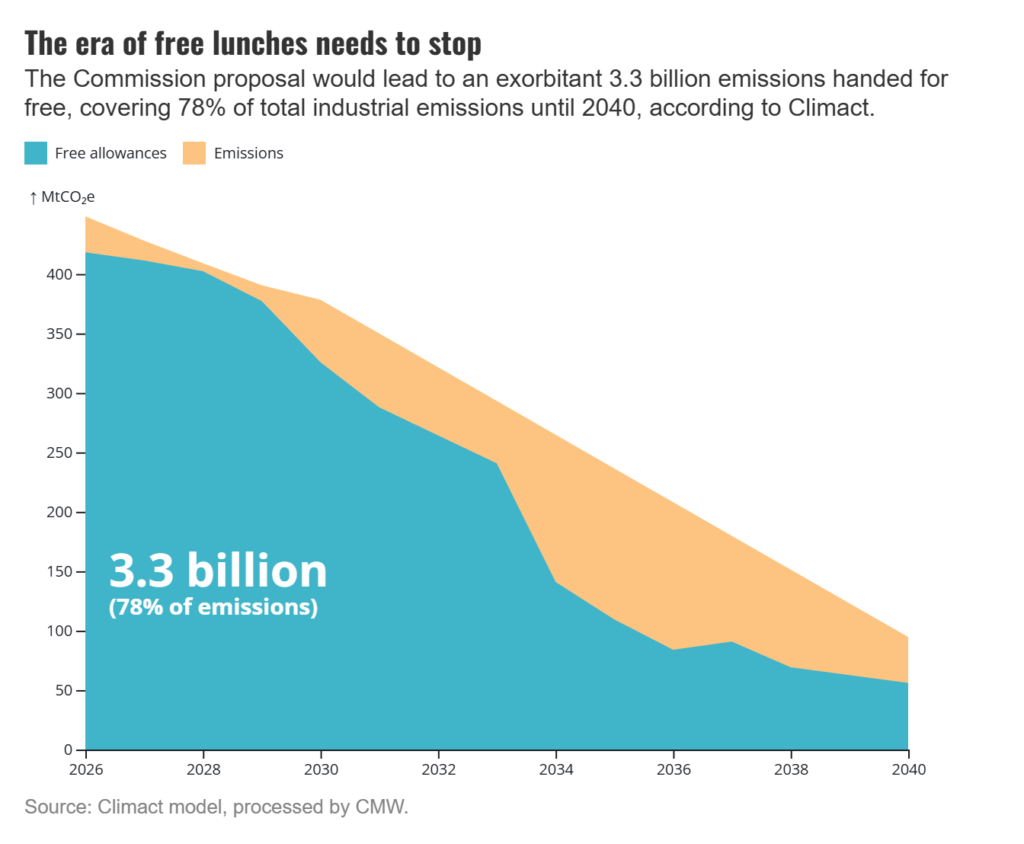
Such huge free pollution subsidies to industry are a massive waste of public resources. They come at the detriment of state budgets and perpetuate fossil fuel consumption in Europe. Free allowances must not continue to be handed out without strict conditionalities, ensuring that they at least contribute to investment in zero-carbon industrial transformation. It is therefore imperative that all remaining free allocation comes with a pre-condition that it is linked to investments in transformative emission-reducing actions and processes.
The new proposal for conditionality may not be enough
The last EU ETS review introduced conditionalities to receive free allocation for the first time. For example, free allocation to the most pollution-intensive installations is reduced by 20% if they fail to implement a climate neutrality plan.
In the new proposal, the Commission suggests to make existing conditionality requirements more extensive. From 2031, the Commission suggests that all ETS installations submit an ‘Invest in EU and decarbonisation plan’ consistent with 2050 climate neutrality, when they apply for free allocation. Such plans must outline decarbonisation measures and investments equivalent to the full economic value of the awarded free allocation. 80% of the free allocation is disbursed once a plan has been approved by the competent authority and the remaining 20% is only allocated upon confirmation that the company’s EU-based decarbonisation investments have been implemented. The top 10% best performing installations – those considered least carbon intensive, through somehow questionable calculation methodologies – would be exempted. The Commission also suggests a clawback mechanism, requiring any industrial installations that opt to relocate outside of the EU to return any awarded free allowances.
While this constitutes an improvement relative to existing rules, the bar remains very low. All free allowances, not just 20%, should be attached to proven additional decarbonisation investments and not only theoretical plans.
The Commission’s proposal also lacks explicit social safeguards and conditionalities for free allocation to be awarded. While the clawback mechanism related to industry relocation outside of the EU is a positive step forward, no explicit conditions are made to ensure and maintain quality jobs at the facilities.
Baseline requirements should be tied to the possibility of receiving free allowances, as this is already the case for other public funding schemes: failure to meet basic requirements such as complying with Union and national labour and social legislation, and respecting rules on collective bargaining should automatically disqualify installations from receiving free allocation. Similarly, installations that do not comply with existing environmental legislation should be disqualified.
What’s next?
Policymakers must use this ETS1 review to accelerate phase out of all free allowances to industry to eliminate freebies once and for all. After two decades of the EU ETS the inefficiency of freebies is well proven, carbon leakage is not.
The competitiveness issues of European industry are not driven by and won’t be solved by ETS. The ETS spoon-feeding heavy industry has been allowed to persist for too long and must stop.
In the meantime, all freebies must come with strict strings attached, ensuring that all subsidies awarded to industry are fully invested into industrial decarbonisation and exclusively for installations complying with prescribed environmental and social requirements.
The era of free lunches needs to stop.