
EU draft rules to certify carbon sequestration and emissions reductions fall short of the scientific demands outlined in Article 6 of the Paris Agreement, new analysis shows. EU policymakers must significantly improve them before formal adoption.
The European Commission is in the final drafting stage of rules to certify carbon farming activities (soil carbon sequestration, afforestation and peatland rewetting) under the EU’s Carbon Removals and Carbon Farming (CRCF) Regulation.
As was the case with the rulebook for permanent removals, recently adopted by the European Parliament and Council, the CRCF draft methodologies for carbon farming are weaker than the already imperfect requirements set by Article 6.4 of the Paris Agreement, also known as the Paris Agreement Crediting Mechanism (PACM). This makes them unsuitable for demonstrating genuine climate benefits with no adverse environmental or social impacts.
Why compare CRCF and Article 6?
According to the EU’s own legislation, the European Commission is obliged to assess whether the CRCF is aligned with Article 6 by 31 July 2026. This makes sense from a broader policy perspective: to preserve its reputation and remain a relevant climate leader on the international stage, the EU should set rules that, at the very least, meet Article 6 standards.
Both the PACM and the CRCF operate as voluntary carbon crediting mechanisms, and it is crucial that they set rules for certifying activities and issuing carbon credits that are compliant with climate science. The rules are meant to quantify the overall climate benefits – removals, temporary sequestration, or emission reductions – of activities seeking certification. These activities are implemented through dedicated practices; for instance, planting cover crops on agricultural land enhances carbon sequestration in soils.
Under both the PACM and the CRCF, projects will have to meet the following requirements to obtain certification: quantifying the carbon reduced or eliminated (permanently or temporarily), establishing additionality to ensure that activities go beyond existing funding and/or legal requirements, managing non-permanence, and ensuring sustainability. Collectively, these are known as the “quality criteria”.
Since these criteria are broadly the same for both frameworks, the PACM and the CRCF are indeed comparable. It is the way these criteria have been applied that differs. According to an analysis we commissioned to the Oeko-Institut, the EU framework scores worse.
Quantification: High risks of overestimation
For the CRCF, quantification approaches, that is, the manner in which the climate benefits of a particular activity will be measured, are flexible. Operators can choose between models, direct measurements, proxies or emission factors, allowing operators to select the method that is most favourable to their project, as opposed to one that applies conservative calculations to undertaken actions. The rules also fail to account for uncertainty in a robust manner, which is crucial given that calculations are largely based on assumptions.
The list of carbon pools – that is, natural reservoirs that store, accumulate, or release carbon – and emission sources used to quantify the total sequestration or reduction of CO2 is both unclear and incomplete. For instance, the rules broadly refer to “living biomass”, without specifying whether this means above-ground or below-ground biomass. The former means biomass above the soil, such as the stem, branches, seeds. The latter covers the roots. At the same time, emissions from livestock and indirect emissions resulting from the conversion of land into other uses – known as indirect land-use change (ILUC) – are excluded from the calculations. Together, these risk overestimating the total carbon sequestered or reduced.
As for baselines, these are the starting point against which progress is measured following a particular intervention (i.e., what was the carbon stock prior to planting cover crops?). For stronger accuracy, measuring the existing situation before project implication should be required. However, in certain instances, the CRCF allows a baseline of 0 tonnes to be assumed. Also, the CRCF does not require baselines to be updated following the renewal of the activity. This is vital to account for changes in carbon stocks in the plot of land being certified, for instance, due to weather impacts.
Under PACM, all carbon pools and emission sources must be identified, including all potential sources of leakage. Sources of uncertainty, such as assumptions related to baselines or associated emissions, must also be systematically addressed. Moreover, all baselines must be set below business-as-usual levels and updated accordingly.
Further, PACM includes a provision to increase the ambition of the baseline over time, to better align it with net-zero goals. This is done by lowering the baseline by 1% each year, regardless of the situation on the ground. It also applies to all activities.
By contrast, the CRCF incorrectly uses this ‘adjustment’ to update the baseline rather than to increase its ambition. Also, it is only applicable after the renewal of the activity, should it be renewed, and is restricted to projects reducing direct and indirect N2O emissions from managed agricultural soils, as opposed to all activities. Note that downward adjustments under the PACM were never meant to replace updates to baselines, which are always necessary to reflect changes in parameters and assumptions used to establish the baseline.
Additionality: credits for already successful projects?
Additionality is composed of several parts, but includes an “incentive effect” test, which requires proof that the operator would not have engaged in the activity without the prospect of certification. This involves a prior consideration test, namely requiring project proponents to clearly demonstrate that the incentives from carbon credits were considered in the decision to implement the activity. It is a safeguard that effectively prevents projects that have been successfully operating for years from receiving credits.
To address this, the PACM requires operators to submit a notice of prior consideration to its secretariat within 180 days of the decision to implement the activity. The CRCF, however, undermines this for activities beginning in 2023 – the start year of the current Common Agricultural Policy period – and activities operating under a certification scheme before its recognition under the CRCF are assumed to be additional.
Otherwise, the CRCF provisions are largely modelled on the PACM, particularly with respect to the financial viability test, which is needed to avoid crediting activities that are financially viable without the need for revenues generated from CRCF units.
Non-permanence: risks not managed
With carbon farming activities, previously stored carbon can be released back into the atmosphere due to land management practices or natural disturbances. Provisions are therefore needed to manage these reversal risks. For agricultural activities, the CRCF sets risk rates, which determine the size of the buffer pool, i.e. the total amount of credits put aside to compensate for reversals. Yet these sizes are particularly low, risking there being too few credits available in the buffer to compensate for reversals. In addition, activities deemed to be of “high-risk” are not excluded. For afforestation, the rules refer operators to a Commission database, while no risk rates apply for peatlands. In addition, risk assessments must only be carried out for agricultural activities and these only cover unavoidable risks.
By contrast, the PACM prescribes a reversal risk assessment for all activities, covering both avoidable and unavoidable risks and requires inclusion of a risk mitigation plan. The risk assessment determines the percentage of credits to be set aside for the buffer pool.
In addition, under the CRCF, risk assessments and liability mechanisms do not apply to peatland rewetting, as the draft falsely assumes that achieved emission reductions are permanent and therefore not subject to reversal risks. This too is a deviation from the PACM (and scientific consensus), which explicitly refers to peatlands as carrying reversal risks and must therefore be subject to risk assessment and liability rules.
Sustainability: another box-ticking exercise
Finally, on sustainability, the CRCF methodology merely refers to existing EU legislation, with no clarity on how this will be monitored and verified in practice. Meanwhile, the PACM provides a step-by-step procedure for assessing potential negative environmental and social impacts, requiring them to be monitored and reported on.
Comparison overview
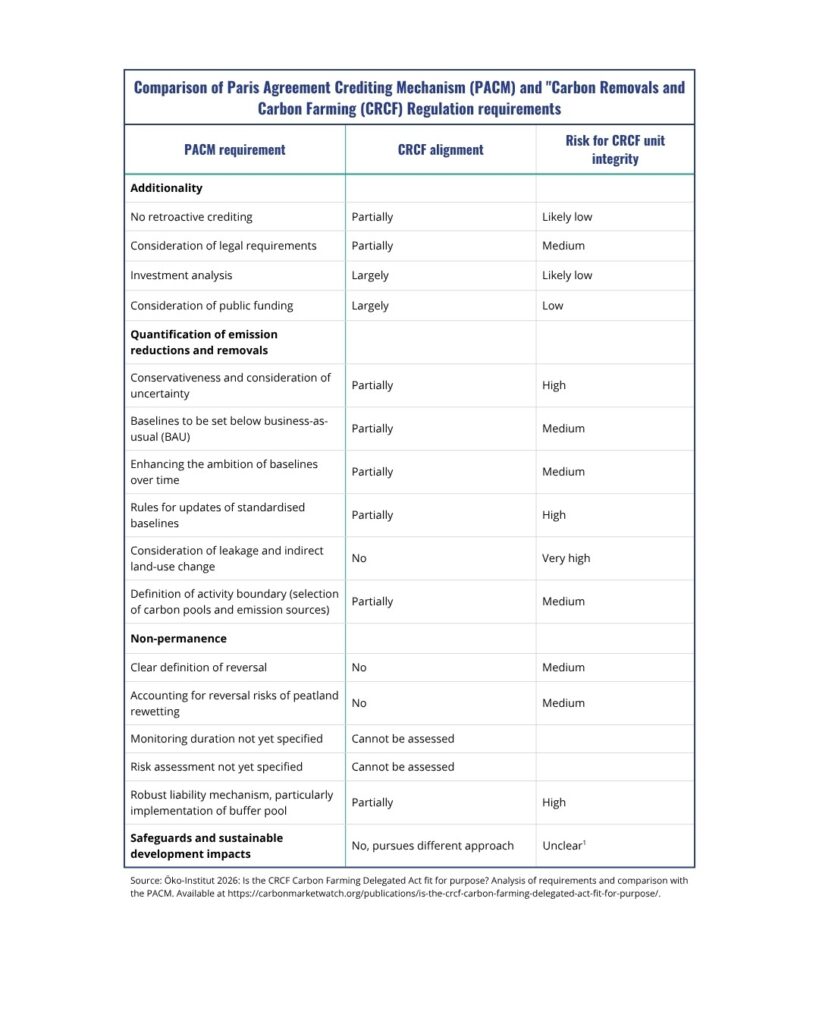
Overall, it is pretty clear that PACM standards frequently exceed those under the CRCF. The table below provides an overview of this, illustrating the level of risk this poses for unit integrity:
What now?
Over the past few years, CMW has been following and contributing to discussions on the CRCF carbon farming methodologies through active participation in the Carbon Removals Expert Group. This has involved providing feedback on draft versions of the methodologies, with the support of Oeko-Institut, shared by the European Commission in November 2024, April 2025, January 2026 and April 2026.
Many experts have raised concerns since the start of the process (see here, here and here). This year, NGOs united on key demands for necessary changes and subsequently denounced the failure to implement such demands.
The public consultation of February 2026 also drew criticism from civil society organisations (see here, here and here), think tanks (see here and here) and member states, calling out methodological flaws that ought to be rectified.
These risks are particularly acute considering the potential uses of issued units, an issue also explored in Oeko’s report. While the CRCF does not clarify the end use of such credits, intentions to use these for meeting national and corporate climate targets are worryingly still on the table. Offsetting is problematic, as it conveys the false idea that emissions can continue, and is based on the assumption that temporary mitigation and permanent emissions are equivalent. Yet temporary activities, such as carbon farming are subject to reversal risks, meaning use of carbon credits on the basis of these draft methodologies could actually lead to more emissions in the atmosphere.
Crucially, these dangerous missteps distract from the real goal: reducing emissions as much and as quickly as possible. This is particularly relevant for the land sector, which needs better regulation, not simplification and voluntary action. The sink is declining, soils are depleted, and emissions reductions, particularly from agriculture, have seen little progress.
Additionally, it offers a false solution to the sector’s ills: The EU must not bet the farm on credits. Benefits are difficult to measure and non-permanence is difficult to manage. This can lead to overestimations and ultimately greenwashing, particularly where credits are used to compensate emissions. Activity-based systems that are free from complex monitoring, reporting and verification procedures are thus better suited for land-based activities.
Without stronger safeguards, these rules pose a risk to net-zero. Policymakers must address these shortcomings and at least align its CRCF methodologies with the basic rules of the PACM. This would not only benefit the climate, ecosystems and societal needs, but is also necessary should the EU choose to remain credible on the international climate stage.