
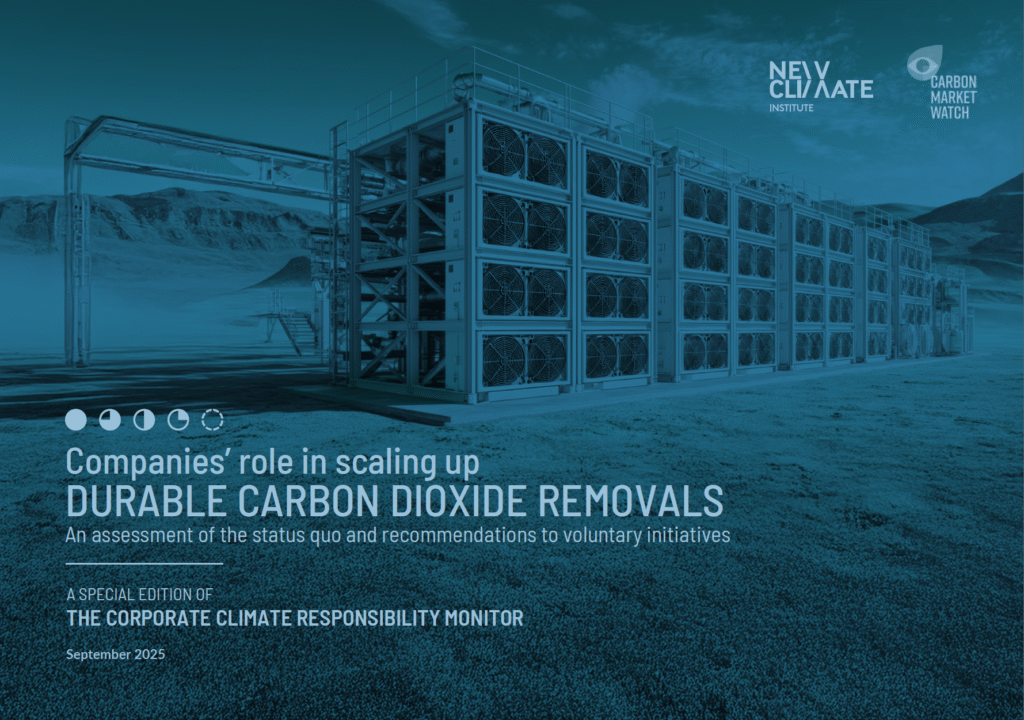

This special edition of our flagship Corporate Climate Responsibility Monitor (CCRM) analyses the carbon removal strategies of 35 major companies across seven sectors. This joint initiative of NewClimate Institute and Carbon Market Watch reveals critical gaps in transparency, integrity, and credibility.
The corporate world has substantially increased its use of both non-durable and durable carbon removals, while often not providing the clarity on what they are using and for what. Companies are investing in durable removal technologies for the achievement of net-zero targets and the production of synthetic aviation fuels.
A surge in low-quality, non-permanent carbon removal overshadows the essential scaling up of durable, long-term solutions.
The investigation found conclusive evidence of carbon removals being counted by some corporations and national governments towards their separate climate targets, undermining global efforts. The issue is likely to be more widespread than the examples suggest.
None of the 35 companies provided sufficient information and detail to guarantee the environmental and social integrity of their carbon removal projects. Transparency is sorely lacking.
“Tech and fossil fuel giants are treating carbon removals as a brand new licence to pollute. Without urgent regulation to enhance transparency, enforce social and environmental guardrails, and combat greenwashing, companies like Total, Shell, ExxonMobil and Apple will continue to place cheap bets on short-lived and vulnerable nature-based removals at the planet’s expense. These so-called net-zero pledges will collapse under their own contradictions – wasting time we’ve already run out of, while misleading investors, consumers and regulators.”
Wijnand Stoefs – Lead expert on carbon removals, Carbon Market Watch
The duty to remove:
The current framing of removals needs to change. Carbon removals must be treated as a scarce resource and a public good.
Millennia-long must be the standard:
The definition of permanence needs to be acknowledged as millennia-long. Carbon removed from the atmosphere and stored, often in vulnerable states, for less than 1,000 years does not truly neutralise ongoing emissions from the long carbon cycle.
Emissions cuts before removals:
Underlying business models must be transformed and aligned with the Paris Agreement goal of limiting global temperature rises to 1.5°C before allowing any use of carbon removals. For instance, the aviation, electrical utilities and fossil fuels sectors need to slash demand or to run on renewables.
Separate target for real-world impact:
Given the remaining uncertainty surrounding commodity certificate constructs like mass balance and book-and-claim, for which no physical traceability from the certificate to the commodity is guaranteed, companies should abstain from counting emission reductions associated with their purchases towards target achievement. Standards should provide clear guidance on this.
We use cookies to improve your experience on our site. By using our site, you consent to cookies. You can configure your cookie setting.
Manage your cookie preferences below:
Essential cookies enable basic functions and are necessary for the proper function of the website.
Statistics cookies collect information anonymously. This information helps us understand how visitors use our website.
Google Analytics is a powerful tool that tracks and analyzes website traffic for informed marketing decisions.
Service URL: policies.google.com (opens in a new window)
Stay in touch and receive our monthly newsletter, campaign updates, event invites and more.